How is the Uruguay Climate?
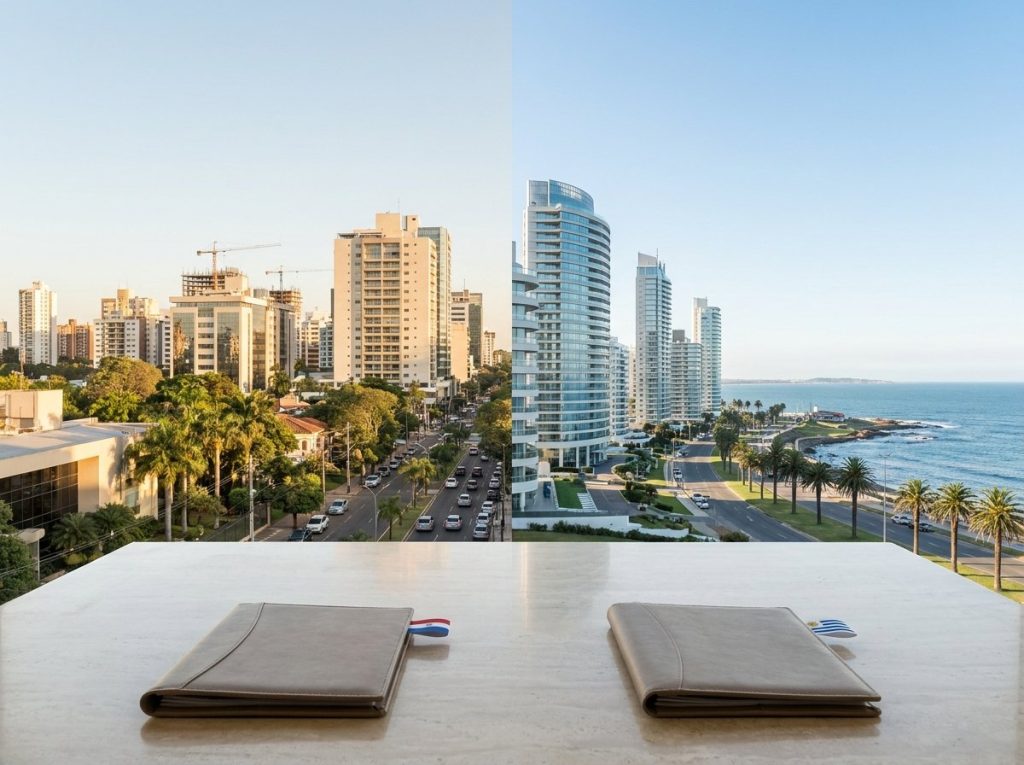
Uruguay is often described as having a temperate climate. That is accurate, but it is not sufficiently precise for an international buyer deciding between Punta del Este, Montevideo or a location farther inland.
The Uruguayan Institute of Meteorology (INUMET) places the country within one broad climatic type. Uruguay is small, comparatively flat and does not contain the mountain barriers that create dramatic climatic divisions in larger countries.
Yet INUMET’s own observations reveal a meaningful gradient. Average annual temperatures run from roughly 16 °C along the Atlantic coast of Rocha to around 19 °C near Artigas in the far north.
That difference is significant in practice. Ocean exposure, latitude and distance from the coast alter summer heat, winter nights, wind, rainfall patterns and the thermal demands placed on a home.
For an international property buyer, climate therefore belongs within location and building due diligence rather than being treated simply as a lifestyle footnote.
Executive summary
- Uruguay has four genuine seasons, reversed relative to Europe and North America.
- Its broad climate is warm-temperate and humid with no defined dry season.
- Rainfall occurs throughout the year rather than being confined to one wet season.
- Average annual temperature rises markedly from the Atlantic southeast toward the north.
- Punta del Este has the strongest direct ocean influence of the five locations examined.
- Montevideo remains coastal but is somewhat less ocean-dominated.
- Durazno displays greater inland temperature amplitude.
- Paysandú and Artigas experience substantially warmer summers.
- Snow is exceptional; frost is not, particularly inland.
- INUMET estimates annual sunshine at roughly 2,300 hours on the ocean coast and as much as 2,600 hours around Salto.
How Uruguay’s climate is classified
INUMET describes Uruguay through the Köppen system as temperate, humid, rainy and without a dry season, with the warmest month exceeding 22 °C. In the internationally familiar ordering of the Köppen-Geiger codes, this profile is generally written Cfa.
The English label “humid subtropical” can create the wrong impression. Uruguay is not tropical. Winter is clearly present, cold fronts reach the country and inland frost occurs.
The equally important distinction is rainfall. Uruguay does not normally develop the sustained summer drought associated with Mediterranean climates. Rain may fall during any month of the year.
Five locations, one clear climatic gradient
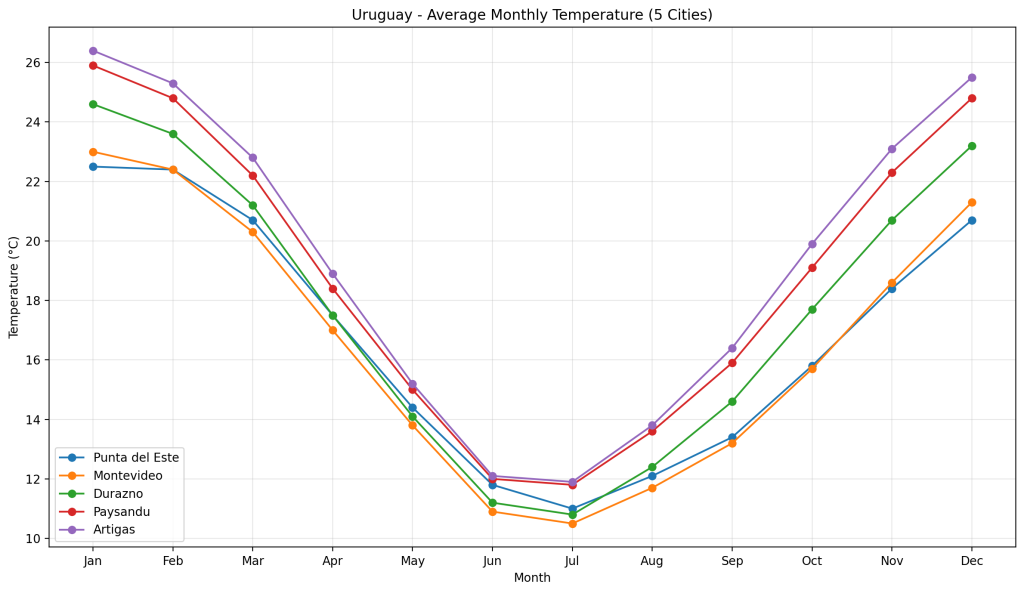
INUMET’s 1991–2020 climate normals make the geographic pattern particularly easy to see.
| Location | Annual mean temperature | January mean | July mean | Annual rainfall | General character |
|---|---|---|---|---|---|
| Punta del Este | ≈ 16.6 °C* | ≈ 22.0 °C* | ≈ 11.1 °C* | ≈ 1,134 mm* | Ocean-moderated and windy |
| Montevideo / Carrasco | 16.8 °C | 22.6 °C | 10.6 °C | 1,163 mm | Balanced coastal climate |
| Durazno | 17.2 °C | 23.7 °C | 10.7 °C | 1,258 mm | Inland transition |
| Paysandú | 18.6 °C | 25.1 °C | 11.9 °C | 1,292 mm | Warmer, more continental |
| Artigas | 19.6 °C | 25.8 °C | 13.3 °C | 1,525 mm | Warmest subtropical profile |
* Punta del Este is not one of the 16 stations included in INUMET’s national 1991–2020 table. The figures shown are from a local secondary climatological dataset used for comparison. INUMET separately publishes official 2014–2024 climatological material for nearby Laguna del Sauce. The figures for Montevideo, Durazno, Paysandú and Artigas are based on INUMET’s 1991–2020 normals.
Punta del Este: the Atlantic makes the difference
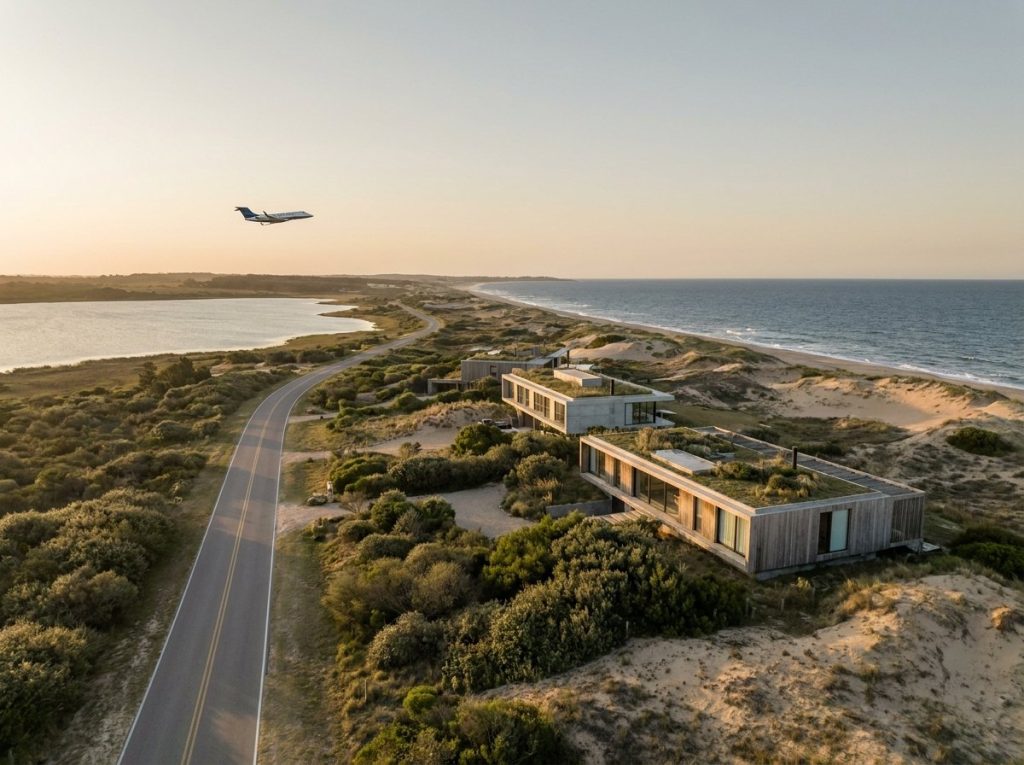
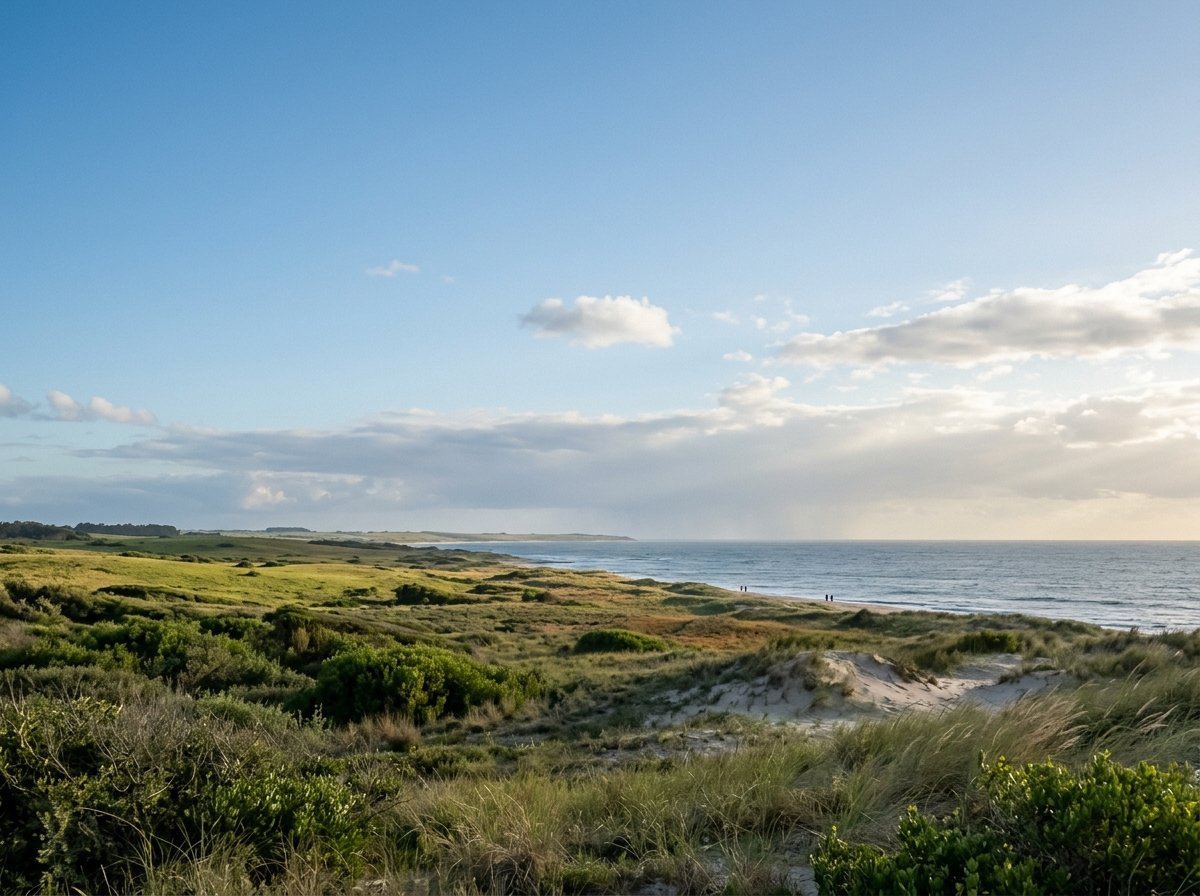
Punta del Este’s location between the Río de la Plata system and the open Atlantic strongly shapes its climate.
The most noticeable effect occurs in summer. Sea breezes and the thermal inertia of the ocean moderate heat more effectively than in inland Uruguay. Hot days can certainly occur, but average summer conditions are milder than in Paysandú or Artigas.
Winter tells a different story. Recorded temperatures are not particularly severe, yet wind and maritime humidity can make a 10–12 °C day feel considerably cooler than the number alone suggests.
This matters when buying property. A home designed primarily for January occupation may perform poorly during July if glazing, insulation, heating and wind protection were treated as secondary considerations.
Coastal exposure also introduces salt. Material specifications, metalwork, exterior equipment and maintenance cycles deserve additional scrutiny close to the ocean.
Montevideo: a highly balanced coastal profile
At Carrasco, the 1991–2020 annual mean temperature is 16.8 °C. January averages 22.6 °C and July 10.6 °C.
Average daytime highs are approximately 27.3 °C in January and 14.5 °C in July. This produces unmistakable seasonality without a routinely severe winter.
Montevideo remains strongly influenced by the Río de la Plata and the nearby Atlantic, but less directly by the open ocean than Punta del Este.
For year-round urban living, it offers one of Uruguay’s most moderate overall climate profiles.
Durazno: where inland amplitude becomes visible
Durazno is useful as a climatic midpoint. Its annual mean of approximately 17.2 °C is only modestly above Montevideo’s, yet daily and seasonal temperature swings become more pronounced.
Summer heat is stronger and winter nights can be colder. Frost deserves consideration for gardens, rural assets and building design.
From a property perspective, this places greater emphasis on a building envelope capable of performing in both summer and winter rather than relying on the relatively narrow thermal range of a maritime location.
Paysandú: warmer does not mean drier
Paysandú’s annual mean rises to around 18.6 °C and its January mean to approximately 25.1 °C.
The summer cooling requirement is therefore materially different from the Atlantic coast. Shading, natural ventilation, air-conditioning capacity and landscape design become more important.
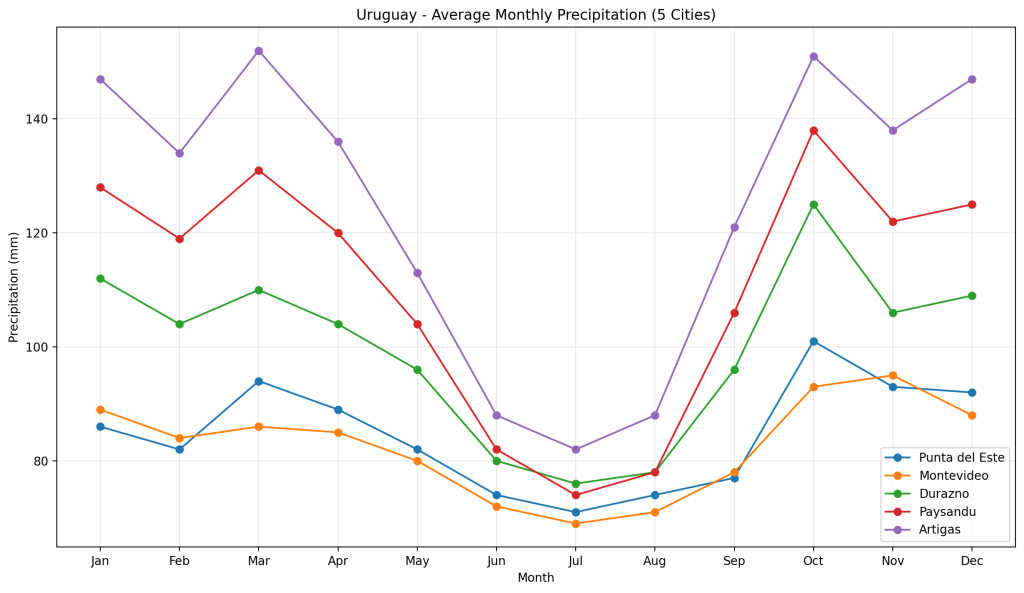
Yet Paysandú is not a dry-climate counterpart to coastal Uruguay. Its average annual rainfall is around 1,292 mm, reinforcing an important point about Uruguay: the warmer north is not automatically the drier north.
Artigas: Uruguay’s warm end of the spectrum
Artigas sits near the warmest part of INUMET’s national temperature map. Its 1991–2020 annual mean is approximately 19.6 °C and January averages around 25.8 °C.
Average annual precipitation is approximately 1,525 mm, making it both warmer and wetter overall than Montevideo.
Despite that subtropical character, winter remains a real season and cold-air outbreaks can still produce frost.
What do Uruguay’s four seasons actually feel like?
Summer: December to February
Summer is warm throughout Uruguay and hottest inland and in the north. Punta del Este benefits most clearly from marine moderation. This is also the peak coastal tourism season.
Autumn: March to May
Temperatures fall progressively and the season can be particularly comfortable. Rapid changes remain possible as fronts move across the country.
Winter: June to August
The coast is generally cool rather than severely cold. Wind and humidity are important comfort factors. Inland areas experience colder nights and more frost.
Spring: September to November
Temperatures recover quickly but variability is high. Warm northern air and cooler southern systems can alternate, sometimes generating sharp temperature changes and thunderstorms.
Rainfall: no monsoon and no Mediterranean dry summer
Uruguay receives precipitation year-round. The monthly distribution varies by region but no sustained national summer dry season defines the climate.
Year-to-year variability can nevertheless be substantial. Uruguay’s Ministry of Environment highlights the influence of ENSO. El Niño can increase the probability of heavier rainfall, particularly during spring and autumn, whereas La Niña conditions are associated with prolonged drought risk.
For investors, this distinction matters: a climate normal describes the long-term baseline, not what will happen in any individual year.
Does it snow in Uruguay?
For practical purposes, snow should not be treated as a normal part of Uruguayan winter.
INUMET states that precipitation is generally liquid and that solid precipitation, including snow, is exceptional.
Frost is different. Sub-zero temperatures do occur during cold outbreaks, especially inland. Uruguay therefore has a genuine winter, simply not a regularly snowy one.
Sunshine: wetter than the Mediterranean, but not a low-light climate
INUMET estimates average annual sunshine across Uruguay at roughly 2,500 hours. The ocean coast receives around 2,300 hours while the figure rises towards approximately 2,600 hours around Salto.
This is an important counterpoint to rainfall totals exceeding 1,000 mm. Uruguay can be relatively wet in annual millimetres while still receiving substantial sunshine.
International climate analogues: which comparisons actually hold up?
Climate comparisons become misleading when they are based on a vague “feel”. We therefore retained only comparisons supported by temperature profiles, rainfall and maritime context.
| Uruguayan location | Useful analogue | Why it works | Important difference |
|---|---|---|---|
| Punta del Este | Wollongong, Australia | Similar coastal latitude, ocean moderation, warm summers, mild-cool winters and historical annual rainfall close to 1,130 mm. | The reference periods differ and monthly rainfall distribution is not identical. |
| Montevideo | Sydney, Australia | Both are Southern Hemisphere coastal cities with moderate seasonality. Carrasco averages about 1,163 mm of annual rain versus roughly 1,211 mm at Sydney Observatory Hill. | Sydney is somewhat warmer overall. |
| Artigas | Porto Alegre, Brazil | Both sit close to a 20 °C annual mean, have hot summers, recognisable winters and annual rainfall around 1,500 mm. | Porto Alegre’s rainfall is distributed differently, with relatively more winter rain. |
| Durazno / Paysandú | No formal twin selected | Their Uruguayan climate position is clear. | The foreign cities reviewed diverged too far in either rainfall or temperature to justify a credible one-to-one label. |
Why Biarritz and Portugal are not true climate twins
Biarritz makes intuitive sense as a lifestyle reference for Punta del Este: both are Atlantic coastal destinations where maritime weather matters. But the data do not support calling them climate twins.
Météo-France’s 1991–2020 normals for Biarritz show approximately 1,474 mm of annual precipitation and only about 1,921 hours of annual sunshine. Its annual average minimum and maximum temperatures are 10.6 °C and 18.4 °C respectively. Biarritz is therefore cooler, wetter and less sunny overall than Punta del Este.
Mainland Portugal is an even weaker full-year analogue. Portugal’s IPMA identifies most of the mainland as Csa or Csb: temperate climates with dry summers. Uruguay’s defining “f” characteristic is the absence of a dry season.
A Portuguese coastal city may match individual Uruguayan temperatures during certain months, but its precipitation regime follows a materially different pattern.
Why climate matters to an international property buyer
Solar orientation
In the Southern Hemisphere, north-facing exposure generally provides the most useful winter solar gain. Orientation should therefore be considered alongside glazing, shading and terrace design.
Coastal wind and salt
In Punta del Este, La Barra and José Ignacio, specifications for windows, exterior metals, fasteners and mechanical equipment can materially affect long-term maintenance.
Winter performance
A mild average winter is not the same as a home requiring no heating. Insulation, glazing and heating performance matter for year-round occupation.
Heat management inland
In Paysandú and Artigas, summer shading, cooling and ventilation deserve greater weight.
Rainfall and site drainage
Lot elevation, drainage, nearby watercourses and official flood-risk information should be reviewed before acquisition. National climate averages cannot substitute for site-specific due diligence.
Opportunities: matching location to lifestyle rather than chasing one “best climate”
Uruguay’s compact geography gives international residents meaningful climate choice without requiring a move between countries.
- Punta del Este and José Ignacio offer the strongest ocean influence and comparatively moderated summers.
- Montevideo combines coastal conditions with a major year-round city.
- Central Uruguay offers stronger seasonality and wider temperature swings.
- Paysandú, Salto and Artigas suit those who deliberately prefer a warmer annual climate.
There is no universally superior climate. The relevant question is which climate best matches the intended use of the property and the owner’s lifestyle.
Climate risks should remain part of due diligence
Uruguay’s generally moderate climate should not be confused with an absence of weather risk.
The Ministry of Environment lists drought, flooding, cold and heat waves, strong winds, tornadoes, hail, frost, heavy rainfall and severe storms among the country’s climate-related hazards.
Coastal areas also require attention to erosion, wave climate and wind exposure.
These national hazards do not establish the risk of any individual property. They reinforce the need for property-level technical and geographic review.
Property climate checklist
- Solar orientation and winter sun exposure.
- Summer shading.
- Insulation and glazing specification.
- Heating and cooling systems.
- Natural ventilation.
- Exposure to prevailing winds.
- Salt corrosion risk near the Atlantic.
- Lot elevation and drainage.
- Flood-risk information.
- Suitability of the building for year-round rather than purely seasonal occupation.
Conclusion
Uruguay’s climate is one of its more understated lifestyle attributes. It offers four real seasons without a normal snow season, substantial sunshine and year-round rainfall rather than tropical or Mediterranean extremes.
The more important finding, however, is regional. Punta del Este is distinctly maritime. Montevideo provides a balanced coastal climate. Durazno introduces greater inland amplitude. Paysandú is notably warmer and Artigas represents the warm, humid northern end of the national spectrum.
For an international buyer, those differences should be treated as part of location selection and property due diligence. Climate affects not only how a place feels in January, but how the building performs in July and how the asset is maintained over many years.
FAQ – Uruguay Climate
What type of climate does Uruguay have?
Uruguay has a warm-temperate, humid climate without a defined dry season, generally identified as Cfa under the Köppen-Geiger system.
Does Uruguay have four seasons?
Yes. Summer runs approximately from December through February, autumn from March through May, winter from June through August and spring from September through November.
Does it snow in Uruguay?
Snow is exceptional rather than a normal winter feature. Frost, however, occurs during cold outbreaks, particularly in inland areas.
Which part of Uruguay has the mildest summers?
The Atlantic coast benefits most from ocean moderation. Punta del Este and the Maldonado-Rocha coastline generally experience less intense average summer heat than inland and northern Uruguay.
Where is Uruguay warmest?
The north and northwest are the warmest regions. Artigas sits near the warm end of INUMET’s national temperature gradient.
Does Uruguay have a rainy season?
No. Rain occurs throughout the year. Monthly and annual totals can vary considerably, including under the influence of El Niño and La Niña.
Is Punta del Este’s climate really similar to Biarritz?
Only in a broad Atlantic-maritime sense. Biarritz is cooler, wetter and less sunny overall. Wollongong in Australia provides a more convincing structural climate comparison, although it is not an exact twin.
Is Montevideo comparable to Sydney?
It is a useful comparison. Both are Southern Hemisphere coastal cities with moderate seasonality and broadly similar annual rainfall totals, although Sydney is somewhat warmer.
What is a useful international comparison for northern Uruguay?
Artigas compares particularly well with Porto Alegre in southern Brazil in annual temperature, hot-summer character and overall rainfall. The monthly distribution of rain is not identical.
What climate factors should property buyers check?
Solar orientation, insulation, heating and cooling, wind exposure, ventilation, drainage, flood risk and, near the Atlantic, salt-related corrosion and material durability should all be reviewed.
Sources
- INUMET – Climate classification
- INUMET – Climate characteristics
- INUMET – 1991–2020 climate normals and statistical tables
- INUMET – Carrasco and Laguna del Sauce climatological information
- Uruguay Ministry of Environment – Climate variability and impacts
- Australian Bureau of Meteorology – Sydney Observatory Hill
- Australian Bureau of Meteorology – Wollongong
- Brazilian National Institute of Meteorology – 1991–2020 climate normals
- Météo-France – Biarritz climate normals
- Portuguese Institute for Sea and Atmosphere – 1991–2020 climate normals
- Climate-Data.org – Punta del Este local climate dataset
Exploring a move or property investment in Uruguay?
If you are assessing Uruguay’s property market, comparing locations or considering a longer-term move, Punta Select Club provides a structured first point of entry for international investors and buyers.
Our role is to provide market orientation, coordinate the buyer journey and, where appropriate, facilitate introductions through authorised local partners.
Disclaimer
This article is published solely for informational and educational purposes. The information reflects data and knowledge available as of 18 August 2026. Climate statistics, regulations, public policies, taxation and market conditions may change over time.
Any information relevant to a relocation, acquisition or investment decision should be independently verified at the time of the project through official sources and appropriately qualified professionals. Climate data represent historical averages and are neither weather forecasts nor guarantees of the conditions affecting any particular location or property.
Nothing in this article constitutes legal, tax, financial, investment or real-estate advice. Individual circumstances require individual assessment and, where appropriate, advice from suitably qualified and authorised professionals.
Punta Select Club operates as a private information, market-orientation and coordination agency for international investors and buyers.