
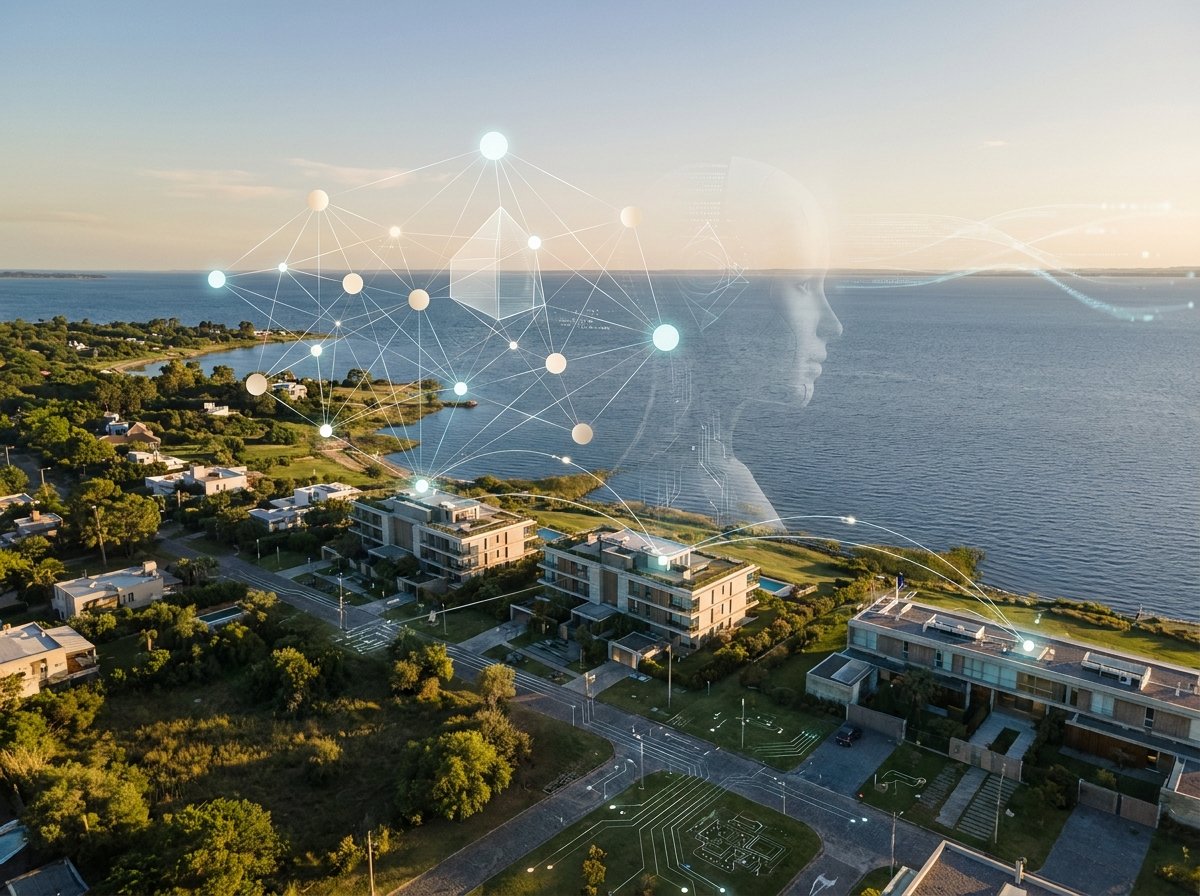
In September 2026, Uruguay became the chosen location for a project that sits at the intersection of technology, real estate, international mobility and urban development. Praxis, a U.S.-based digital community with roots in the technology and venture ecosystem, announced that its first large-scale physical development would begin inside +Colonia, near Colonia del Sacramento on the Río de la Plata.
The announcement attracted attention for two reasons. First, Praxis has spent years presenting itself as a “digital nation” seeking a permanent physical home. Second, it announced a plan to mobilize approximately US$1 billion over three years.
Those headlines are compelling, but investors need a more disciplined framework. +Colonia is an existing urban development with regulatory history and construction already underway. The Praxis agreement is real, but several commercial steps remain incomplete. The US$1 billion figure is a forward-looking investment target, not a cash balance already deployed in Uruguay.
The most useful question is therefore not whether Uruguay is about to receive a billion-dollar “private city.” It is what this decision says about Uruguay’s ability to attract internationally mobile founders, capital, families and high-value projects.
Executive Summary
- Praxis officially announced on 22 September 2026 that it had selected Uruguay for its first city-scale physical development.
- The first phase is planned inside +Colonia, an established urban project near Colonia del Sacramento.
- +Colonia states that its broader site covers approximately 515 hectares and more than 7 kilometres of waterfront.
- Praxis says it intends to mobilize US$1 billion over three years. This should be treated as a target, not as capital already fully funded or disbursed.
- Uruguayan media reports that the agreement involves roughly 350,000 square metres within the wider development and is expected to be implemented in stages.
- At the time of the announcement, the associated land sales had not yet been completed. Initial transactions were expected from 2027.
- The first residents are also targeted for 2027, initially including occupancy of buildings already under construction at +Colonia.
- Praxis has not been granted a sovereign or autonomous jurisdiction. The development remains subject to Uruguayan law, local planning rules and permitting.
- For investors, the strongest signal is Uruguay’s selection after a global search, not the branding around a “digital nation.”
How the Story Emerged
The project reached a wider audience through a New York Times report from Colonia, published in September 2026, while Praxis released its own formal announcement on the same theme. Uruguayan newspapers then examined the commercial structure in greater detail, including the scale of the proposed footprint, the expected phasing and the assumptions behind the billion-dollar figure.
Each source answers a different question. Praxis explains the vision. +Colonia provides location and development information. Uruguayan public bodies show that the project sits inside a formal planning framework. Independent media provide useful checks on what is actually binding, funded or still dependent on future execution.
That layered reading matters. An investor should neither accept promotional language at face value nor dismiss a development simply because the narrative is ambitious. The correct approach is to separate tangible assets, contractual steps, financing assumptions and future projections.
What Is Praxis?
Praxis describes itself as a digital nation made up of founders, entrepreneurs, investors, artists and technology professionals. Its long-term concept is influenced by the “network state” idea: a community is formed online first and later develops permanent physical places for members to live, work and build institutions.
After evaluating several international locations, Praxis selected Uruguay. In its official September 2026 announcement, it cited Uruguay’s natural environment, political and economic stability, institutional strength and the advantage of working alongside an established local development partner.
Its dedicated Praxis Uruguay page describes an initial waterfront phase with private residences, a resort and cultural spaces, with first residents expected during 2027.
Where Exactly Is the Project?
The site is in Colonia del Sacramento, in the department of Colonia, on the Uruguayan side of the Río de la Plata. It is not in Montevideo and it is not in Punta del Este.
According to the official +Colonia website, the wider development spans around 515 hectares, includes more than 7 kilometres of shoreline and begins roughly 800 metres from the Port of Colonia. The first district sits about five kilometres from the historic centre.
The geography is a major part of the investment thesis. Colonia is directly linked to Buenos Aires by ferry while remaining under Uruguay’s institutional and legal framework. It therefore serves a different role from Punta del Este, whose international appeal is more closely tied to premium coastal living, second homes and seasonal high-end demand.
+Colonia Is an Existing Urban Development, Not a Blank-Slate Concept
One of the most important distinctions is that Praxis did not create +Colonia. The urban project predates the current announcement and has its own planning history, active construction and regulatory process.
The Departmental Board of Colonia has documented the project for years through the local planning mechanism known as a Contrato Plan. In April 2026, the Board approved further amendments to the +Colonia planning contract, demonstrating that the development remains subject to ongoing institutional oversight.
The original planning documentation described an initial area of 202.78 hectares and a future second area of roughly 311 hectares requiring additional territorial planning instruments. The relevance for investors is straightforward: +Colonia is not an extraterritorial private enclave. It is a large urban development operating within Uruguay’s legal and planning system.
In July 2025, President Yamandú Orsi visited the site. An official Uruguayan Presidency release described +Colonia as an open urban initiative integrating natural and built environments, with a strong innovation component.
Confirmed Facts, Forward-Looking Targets and What Is Not Yet Established
| Item | Status as of 28 September 2026 | Investor Interpretation |
|---|---|---|
| Praxis selected Uruguay | Confirmed | Formally announced by Praxis. |
| Initial development at +Colonia | Confirmed as an agreed development plan | Praxis intends to build inside an existing urban project. |
| Approx. 350,000 m² | Reported by Uruguayan media | Expected to be implemented in phases, not as one completed acquisition. |
| US$1 billion | Three-year mobilization target | Not equivalent to fully committed or already deployed capital. |
| First residents in 2027 | Announced timetable | A target dependent on construction, purchases and delivery schedules. |
| Independent legal jurisdiction | Not established | Praxis currently intends to operate within Uruguay’s existing legal framework. |
The US$1 Billion Headline: What It Actually Means
Praxis states that it plans to mobilize US$1 billion over the next three years. The wording matters. “Mobilize” describes an intended future flow of investment. It does not mean that US$1 billion is already sitting in an escrow account, fully financed or contractually committed.
El País Uruguay reported that around 2,700 Praxis members had expressed interest or commitment to moving into the development and that a substantial part of the projected investment would come from future housing construction and purchases by community members. The newspaper also reported that the relevant land sales had not yet been completed and were expected to occur progressively.
A subsequent El País investigation noted that the billion-dollar estimate is substantially linked to assumptions about how much those prospective residents could invest if they eventually relocate. For investors, the distinction is critical. It may indicate strong potential demand, but it should not be presented as banked capital.
The New York Times report, available through eKathimerini, adds another layer of caution by describing the current agreement as largely non-binding and noting that material execution questions remain.
Why Uruguay Fits the Praxis Thesis
Institutional Predictability
Praxis places heavy emphasis on political and institutional stability. External benchmarks provide some support for that positioning. In the Henley & Partners / AlphaGeo Global Investment Risk and Resilience Index, Uruguay scores 69.28 out of 100 and ranks 34th globally in the 2026 update. It is a composite risk and resilience indicator, not an investment-return forecast.
Competitiveness for Globally Mobile Wealth
The Henley Private Wealth Migration Report 2026 gives Uruguay a Wealth Mobility Competitiveness Score of 71.8. Henley’s methodology treats scores above 70 as evidence of strong structural positioning for internationally mobile wealth. It also explicitly warns that the score does not measure actual millionaire inflows or predict future migration.
Cross-Border Connectivity
Colonia’s proximity to Buenos Aires gives it a distinctive regional advantage. For certain internationally mobile households, it offers the possibility of living in Uruguay while maintaining quick access to Argentina’s largest metropolitan market.
Relatively Low Friction for Foreign Property Buyers
Foreign buyers can acquire property in Uruguay under the same property-rights framework as nationals, while the U.S. dollar is widely used in real estate transactions. These features can simplify international acquisition, although legal, tax and title due diligence remain essential.
Potential Consequences for Colonia
If the Praxis phase is delivered at meaningful scale, its impact could extend well beyond residential construction. A new population of internationally connected residents may create demand for hospitality, restaurants, private healthcare, schools, professional services, workspace, mobility and cultural venues.
That does not automatically translate into higher real estate values. Pricing effects will depend on actual occupancy, delivery pace, available supply and whether demand broadens beyond the Praxis community itself.
The more durable national signal is that Uruguay is increasingly being considered not only for lifestyle and residential migration, but also as a platform for internationally mobile capital, founders and knowledge-economy projects.
Opportunities International Investors Should Monitor
- Actual residential absorption: completed contracts, closings, handovers and occupancy will matter more than headline community numbers.
- Secondary economic activity: new hotels, restaurants, schools, offices and service businesses can show whether a genuine urban ecosystem is forming.
- The Colonia–Buenos Aires corridor: sustained improvements in connectivity could strengthen Colonia’s structural appeal.
- Demand outside Praxis: liquidity will be more convincing if buyers and tenants are not dependent on a single community.
- Reputational spillover: the arrival of recognised founders or technology companies could attract additional projects and international capital networks.
Key Risks
- Execution risk: a development of this size requires years of construction, infrastructure and administration.
- Funding risk: a future investment target is not the same as committed and available capital.
- Timeline risk: 2027 is an announced objective, not a guaranteed delivery date.
- Demand concentration: Praxis still needs to convert an online community into actual residents and property buyers.
- Planning and permitting risk: each future phase remains subject to Uruguay’s national and departmental requirements.
- Reputational risk: Praxis has generated debate over its cultural and political references. Real estate analysis should remain separate from ideological affinity with the community.
International Comparison: Why Uruguay Is Not the Same as a Private Jurisdiction
Many “startup city” and network-state projects seek special regulatory autonomy. Próspera in Honduras is a useful comparison because it was established under a semi-autonomous legal framework and later became involved in major international litigation after that framework was repealed.
The Uruguayan case appears materially different. The New York Times reports that independent governance is not an immediate requirement for Praxis and that the project currently intends to function within Uruguay’s existing legal system.
That distinction should shape the investment thesis. The value proposition in Colonia should be assessed through conventional fundamentals: location, title, infrastructure, construction quality, comparable pricing, demand, liquidity, governance and execution. It should not depend on the prospect of a future sovereign enclave.
Colonia, Montevideo and Punta del Este: Three Different Market Roles
| Market | Primary Positioning | Investor Lens |
|---|---|---|
| Colonia del Sacramento | Buenos Aires gateway, heritage tourism and new innovation-led development | Watch new resident flows, connectivity and depth of local services. |
| Montevideo | Administrative, corporate, university and service-sector capital | Deeper urban market with broader permanent residential demand. |
| Punta del Este / Maldonado | Premium coast, second homes, international tourism and lifestyle | Higher exposure to affluent regional and international buyers and coastal product. |
This is not a ranking. The three markets respond to different sources of demand and can serve different roles within an international real estate or relocation strategy.
Investor Due-Diligence Checklist
- Verify title, cadastral status, subdivision and the exact legal identity of the property being offered.
- Identify the selling entity, developer, contractual counterparty, guarantees and payment schedule.
- Review the permits, infrastructure obligations and planning rules applicable to the specific phase.
- Do not use the US$1 billion headline as an automatic basis for future valuation assumptions.
- Benchmark sale prices and rents against comparable property outside +Colonia.
- Assess resale liquidity and demand from buyers who are not connected to Praxis.
- Have all contracts reviewed by an independent Uruguayan notary or lawyer and obtain jurisdiction-specific tax advice.
Conclusion
The strongest version of the Praxis story is not that Uruguay is guaranteed to receive a US$1 billion futuristic city. That interpretation combines a future investment target with an urban development that is already real but still evolving.
The more relevant facts are concrete: Praxis selected Uruguay after an international search, +Colonia already has a planning framework and active construction, and Colonia del Sacramento is attracting a type of internationally mobile technology and investor community that has not traditionally been central to the country’s global image.
For investors, the story is worth following as a market signal rather than treating it as a return forecast. The decisive milestones will be completed land transactions, capital actually deployed, infrastructure delivery, occupancy, the arrival of residents and the emergence of a liquid market beyond the initial community.
FAQ – Praxis, +Colonia and Investing in Uruguay
Is Praxis actually building an independent city in Uruguay?
No independent sovereign city has been created. Praxis is planning a large physical community within +Colonia, an existing urban development. The project remains subject to Uruguayan law and local planning rules.
Where is +Colonia located?
+Colonia is in Colonia del Sacramento on the Río de la Plata, close to the El Calabrés area. The developer says the site begins around 800 metres from the Port of Colonia.
Has the US$1 billion already been invested?
No. Praxis says it intends to mobilize approximately US$1 billion over three years. Local reporting indicates that a large share would depend on future investments and property purchases by community members.
When are the first residents expected?
Praxis is targeting 2027. Some residents may initially move into buildings already under construction at +Colonia while the dedicated Praxis area develops.
How large is +Colonia?
The official project website states that the overall site covers roughly 515 hectares and more than seven kilometres of waterfront.
Why did Praxis choose Uruguay?
Praxis highlights political and economic stability, institutional strength, natural environment, available space and proximity to both Buenos Aires and Montevideo.
Could Praxis push Colonia property prices higher?
It may increase demand in certain segments, but there is no automatic price effect. Outcomes will depend on actual occupancy, supply, delivery schedules, entry prices and whether demand extends beyond the Praxis community.
Are Sam Altman and Peter Thiel directly funding the Uruguay project?
That should not be stated as fact. Praxis has received backing from entities linked to the broader technology and venture ecosystem, including Apollo Projects and Pronomos Capital. This does not mean that Sam Altman or Peter Thiel are personally financing the current Uruguay development.
Why should a Punta del Este investor care about a project in Colonia?
Because it broadens the national investment picture. Colonia and Punta del Este serve different demand segments, but Praxis shows that Uruguay is attracting international residents and capital through more than one geographic channel.
Sources
- Praxis – official Uruguay announcement, 22 September 2026.
- Praxis Uruguay – Phase I overview.
- +Colonia – official project site and location data.
- Presidency of Uruguay – official visit to +Colonia, 31 July 2025.
- Departmental Board of Colonia – 2026 amendments to the +Colonia Contrato Plan.
- Departmental Board of Colonia – original +Colonia planning documentation.
- El País Uruguay – agreement structure, footprint and investment projection.
- El País Uruguay – investigation into Praxis and the US$1 billion estimate.
- The New York Times via eKathimerini – field report on Praxis and +Colonia.
- Henley & Partners – Uruguay Wealth Mobility Competitiveness Score.
- Henley & Partners / AlphaGeo – Global Investment Risk and Resilience Index.
- The Wall Street Journal – Praxis 2024 financing announcement and milestone-based commitments.
- France Inter – original link that prompted the source verification.
Considering a Move or Investment in Uruguay?
Punta Select Club provides a structured first point of entry for international buyers and investors seeking to understand Uruguay, the differences between Montevideo, Colonia and the Maldonado coastline, and selected real estate opportunities that may warrant closer review.
Our role focuses on educational information, market orientation, buyer coordination and introductions through authorized local partners when a project requires specialist support.
Disclaimer
This article is published solely for informational and educational purposes. The information, data, estimates and references reflect public information and knowledge available as of 28 September 2026. Real estate developments, construction schedules, investment amounts, public policy, tax rules, regulations and market conditions may change, be delayed or fail to materialize as initially announced.
All information should be independently verified before any investment, acquisition, relocation or wealth-planning decision. This article does not constitute legal, tax, financial, investment, wealth-management or real estate advice, and it is not an offer, recommendation or solicitation to enter into any transaction.
Each situation requires advice from appropriately qualified and authorized professionals in the relevant jurisdictions. Punta Select Club acts as an information, market-orientation, introduction and buyer-coordination agency for international buyers and investors. Punta Select Club is not a real estate agency, broker, law firm, tax adviser, financial adviser, wealth manager or investment fund.