Biarritz is the strongest overall climate comparison. For American readers, Santa Barbara is a useful lifestyle shortcut, yet Punta del Este is wetter, more seasonal and has distinctly warmer ocean water at the height of summer.
What climate does Punta del Este actually have?
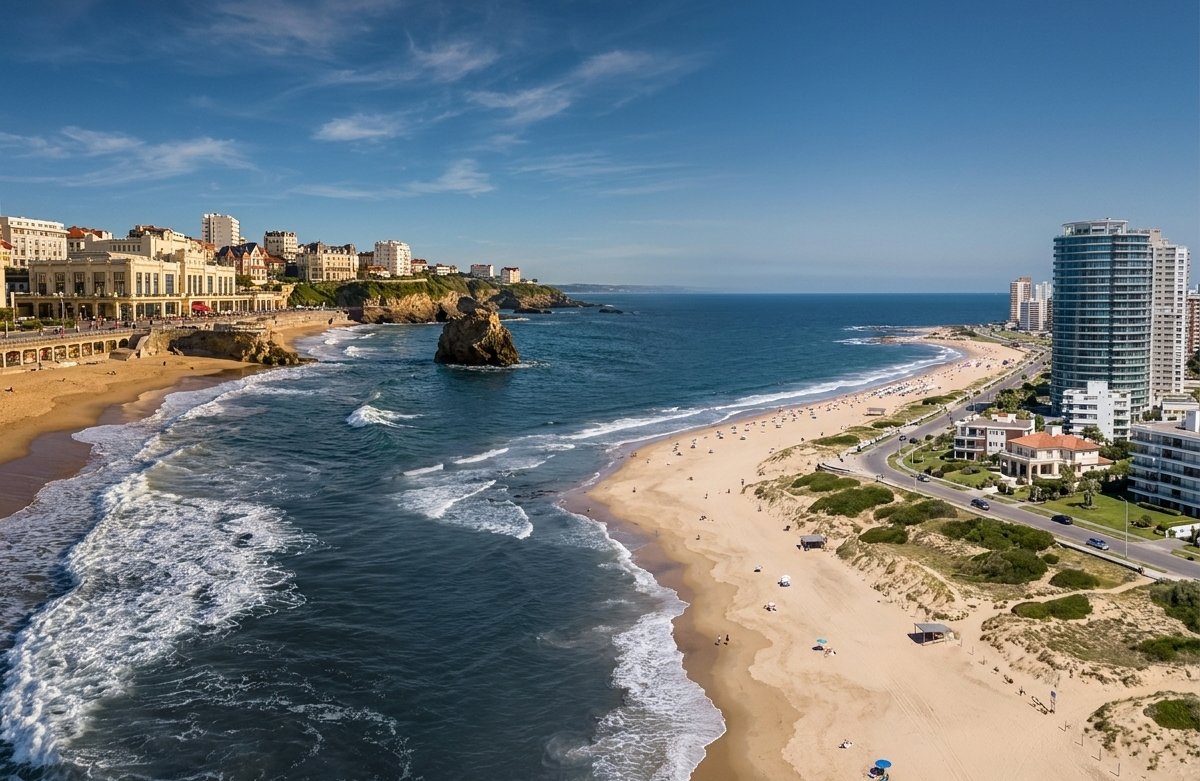
Punta del Este occupies a peninsula where Playa Mansa marks the end of the Río de la Plata and Playa Brava the beginning of the Atlantic Ocean. Uruguay’s Ministry of Tourism uses this geographic distinction explicitly, and it helps explain the local experience: sea breeze, frequent wind, moderated temperature swings and a notable contrast between sheltered and ocean-facing locations.
Depending on the dataset and temperature threshold, the broader area may be described as humid subtropical or temperate oceanic. For residents and buyers, the practical reality is more useful than the label: four recognisable seasons, no persistently harsh winter, no permanently tropical summer and no Mediterranean-style dry season.
Temperatures through the year
| Season in Punta del Este | Months | 1991–2020 coastal reference | Typical experience |
|---|---|---|---|
| Austral summer | December–February | January: 22.4°C mean, 28.1°C average high and 16.7°C average low. | Warm but frequently breezy days, comfortable evenings and peak beach activity. |
| Autumn | March–May | Mean temperature moves from 20.5°C in March to 14.4°C in May. | A long shoulder season with bright spells and intermittent rain. |
| Austral winter | June–August | July: 10.9°C mean, 15.5°C average high and 6.3°C average low. | Cool, sometimes windy and damp; indoor comfort depends heavily on building quality. |
| Spring | September–November | The mean rises from 13.3°C in September to 18.2°C in November. | Variable and breezy, with rapid changes between warm and fresh days. |
Why Biarritz is the best climate benchmark
Once the seasons are reversed, the two coasts show remarkably similar temperature profiles. Rocha records a January mean of 22.4°C and an average high of 28.1°C. Biarritz records an August mean of 21.2°C and an average high of 25.1°C.
Winter is slightly milder in Uruguay: Rocha averages 10.9°C in July, compared with 8.6°C in Biarritz in January. Punta del Este is therefore warmer, but not by the three or four degrees sometimes claimed as a blanket rule.
| Indicator | Punta del Este coast Rocha proxy |
Biarritz |
|---|---|---|
| Peak-summer mean | 22.4°C | 21.2°C |
| Peak-summer average high | 28.1°C | 25.1°C |
| Mid-winter mean | 10.9°C | 8.6°C |
| Annual rainfall | 1,284.8 mm | 1,473.6 mm |
| Days with at least 1 mm of rain | 91 | 141.1 |
| Annual sunshine | 2,344.4 hours | 1,920.6 hours |
“Punta del Este is Biarritz with reversed seasons, slightly milder air, more sunshine and fewer rainy days.”
For Americans: where Santa Barbara fits
Santa Barbara is a helpful reference for a US audience because both destinations combine moderate coastal temperatures, refined residential districts and an outdoor lifestyle without tropical heat. The comparison is strongest at the level of atmosphere and positioning.
Climatically, the differences are substantial. NOAA’s 1991–2020 normals put Santa Barbara’s August mean at roughly 20.5–21°C, with average highs near 25–26°C. Those air temperatures overlap with Punta del Este. However, Santa Barbara receives only around 480 mm of rain a year, overwhelmingly during the cooler months, whereas the Punta del Este coast receives approximately 1,285 mm distributed across the year.
The Pacific is also cooler. Ten-year coastal histories place Santa Barbara’s August water near 19.3°C, versus about 22°C in Punta del Este in January. Santa Barbara therefore communicates the lifestyle, while Biarritz remains the more accurate all-round climate comparison.
The sea: Punta and Biarritz are surprisingly close
Ten-year coastal histories place average January water in Punta del Este at approximately 22°C and August water in Biarritz at approximately 22.7°C. These are not WMO official climate normals, so they should be treated as indicative rather than fixed.
Local exposure matters. Playa Mansa is typically calmer and more sheltered. Playa Brava, La Barra, Manantiales and José Ignacio face the open Atlantic more directly. The same recorded temperature can feel cooler when wind and swell are stronger.
Rain, sunshine and wind
There is no true dry season
Rain is possible in every month. That is a decisive difference from Southern California and the Mediterranean coast. Rocha records around 1,285 mm annually, yet on only about 91 days with at least 1 mm of precipitation. Biarritz receives more rain and spreads it across approximately 141 days.
In practical terms, Punta del Este may experience meaningful rain events, but also longer dry and bright intervals between systems.
More than 2,300 sunshine hours
Rocha records about 2,344 hours of annual sunshine, over 400 hours more than Biarritz. This contributes to the bright coastal character and supports terrace use well beyond the peak summer weeks.
Wind is part of the property equation
Wind often moderates summer heat, but it can increase perceived cold in winter. A buyer should evaluate terrace orientation, floor level, external screens, window specifications and pool exposure rather than relying solely on monthly temperatures.
What international buyers should inspect
- Solar orientation and wind exposure: sea views can come with stronger prevailing winds and salt spray.
- Insulation and heating: a mild climate does not guarantee a comfortable building if thermal bridges and weak glazing are present.
- Ventilation and moisture management: especially important for second homes left closed for extended periods.
- Waterproofing: roofs, terraces, drains, window joints and façades should be assessed for wind-driven rain.
- Marine corrosion: railings, technical equipment and external HVAC units require appropriate materials and maintenance.
- Pool usability: wind protection, cover, depth and heating influence the practical swimming season.
- Common charges: heated pools, dehumidification, façade care and year-round services can materially affect ownership costs.
Mansa, Brava and the eastern coast
- Mansa and Punta Ballena: generally more sheltered conditions, calmer water and sunset orientation.
- The Peninsula: quick access to both coasts, with significant wind exposure in some taller buildings.
- Brava, San Rafael and Rincón del Indio: a stronger open-ocean identity, with more noticeable wind and swell.
- La Barra, Manantiales and José Ignacio: open Atlantic landscapes, low-density options and highly site-specific exposure.
Why climate matters for global mobility
Reversed seasons can be strategically attractive for international families. Punta del Este allows owners to alternate between Europe or North America and the Southern Hemisphere, extend summer or establish a long-term coastal base. Its climate supports extended stays beyond January and February, even though economic activity and rental demand remain more concentrated in peak season.
Frequently asked questions
What is the best time for beach weather?
January and February are normally the warmest months. December and March can offer excellent conditions with fewer visitors, but greater variability.
Can people swim without a wetsuit?
Many can in high summer. Historical January water averages around 22°C, although wind and beach exposure strongly affect comfort.
Is winter cold?
Winter is cool rather than severe. Rocha’s July average high is 15.5°C. Wind and humidity make building quality particularly important.
Is Punta drier than Biarritz?
Yes, in annual volume and especially in the number of rainy days. Rain can nevertheless occur in every month.
Is Punta del Este more like Biarritz or Santa Barbara?
Biarritz is the stronger climate match. Santa Barbara is useful for describing a premium coastal lifestyle, but it is much drier and has cooler summer water.
Do Mansa and Brava feel different?
Yes. They share the regional climate, but Mansa is generally more sheltered, while Brava and the eastern coast are more directly exposed to Atlantic wind and swell.
Planning a Punta del Este project
Punta Select Club offers international buyers a structured first point of entry: market orientation, selected access to certain real-estate opportunities and introductions through authorised local operators, notaries, lawyers and other qualified professionals.
To begin a private and qualified conversation, visit Punta Select Club.
Sources and methodology
- INUMET — 1991–2020 climate statistics, using Rocha as the official regional coastal proxy.
- Météo-France — Biarritz 1991–2020 climate normal.
- NOAA NCEI — 1991–2020 U.S. Climate Normals, used for Santa Barbara.
- Uruguay Ministry of Tourism — Punta del Este, Playa Mansa and Playa Brava.
- Sea temperatures: ten-year coastal histories for Punta del Este, Biarritz and Santa Barbara.
Disclaimer: this article provides general educational information only. It is not real-estate, technical, financial, tax or legal advice. Every acquisition requires independent due diligence and a property-specific assessment.