
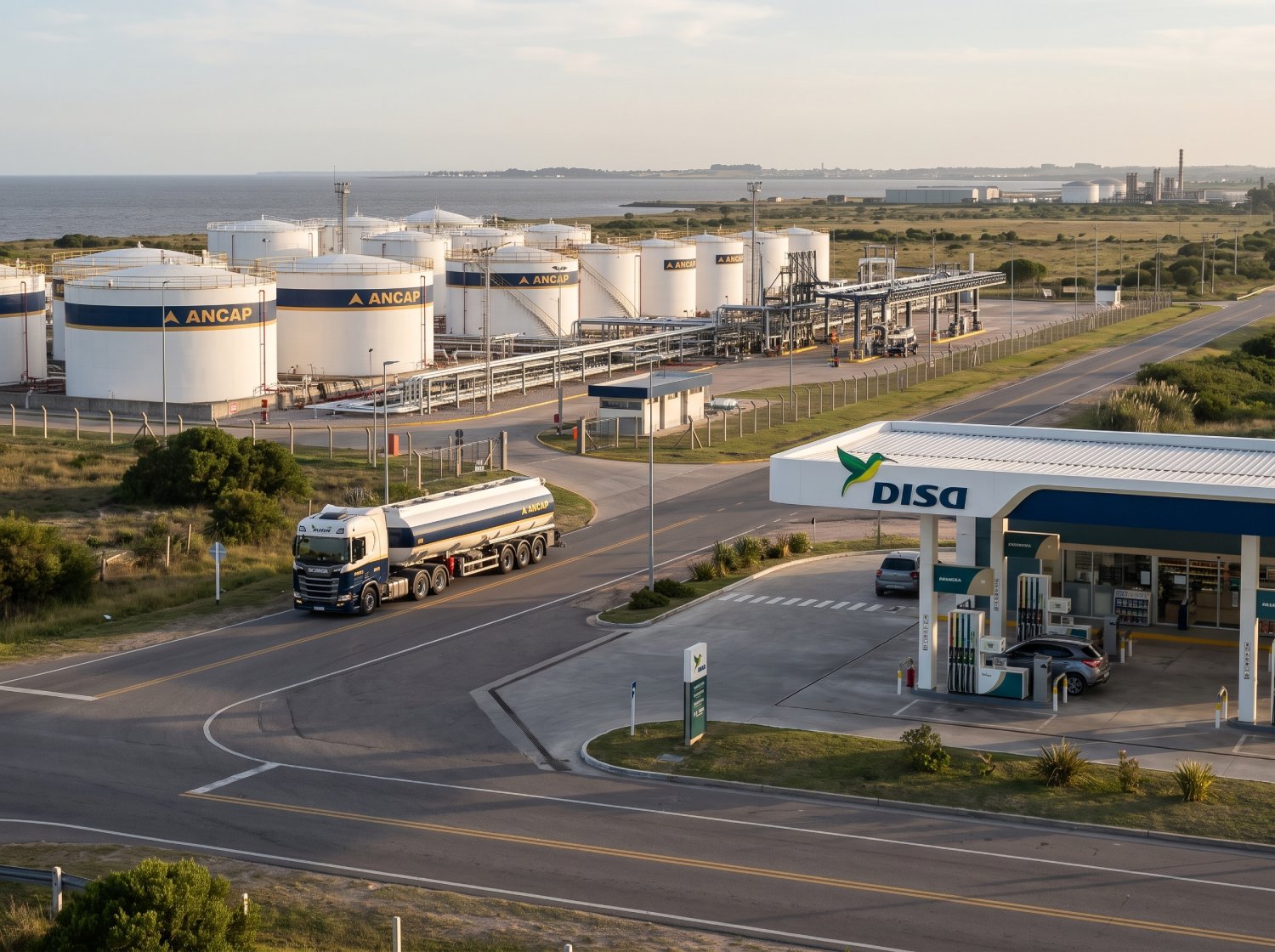
How much the gasoline cost in Uruguay? One upstream system, different brands and uniform prices
Uruguay’s service-station landscape appears competitive. Drivers can stop at ANCAP, AXION Energy or DISA, each with its own branding, shops, promotions and customer experience. Beneath that retail layer, however, the market is unusually centralised. State-owned ANCAP retains a pivotal role in importing, refining, storing and supplying fuel, while the Executive Branch approves maximum retail prices.
This structure explains an observation frequently made by newcomers: the same grade of petrol is sold at the same posted price across different brands and locations. It also explains why station employees may say that the product is essentially the same.
That answer is broadly correct at the upstream level, but it requires qualification. The networks share a common supply architecture and national product specifications, yet public documents do not prove that every final litre carries an identical additive package or has passed through identical station-level handling.
Executive summary
- ANCAP was created under Law No. 8,764 of 15 October 1931 and administers Uruguay’s historic state monopoly over key upstream petroleum activities.
- The La Teja plant in Montevideo, operational since 1937, is Uruguay’s only oil refinery.
- The main consumer-facing networks are ANCAP, commercially managed mainly through DUCSA, AXION Energy, operated by Nexzur, and DISA.
- Esso was progressively rebranded as AXION. DISA acquired Petrobras’ Uruguayan downstream business in 2021.
- ANCAP states that its Súper 95 petrol is marketed through all service stations in the country. This supports the existence of a shared upstream product platform, but not a claim of perfect chemical identity across every brand and batch.
- URSEA calculates the Import Parity Price and a reference retail price. The Executive Branch approves the ex-plant and maximum retail prices.
- Since July 2025, the standard methodology has used two-month retail-price adjustments and a plus-or-minus 7% stabilisation rule per adjustment.
- For investors, the main variables are international prices, exchange rates, taxation, public policy, regulated margins, logistics and actual operational consumption.
1. ANCAP and the origins of Uruguay’s gasoline model
ANCAP stands for Administración Nacional de Combustibles, Alcohol y Pórtland. It was created in 1931 as part of a broader Uruguayan policy of placing strategic infrastructure under public control. Its founding law assigned it responsibility for the national fuel monopoly and for importing, processing and selling petroleum and petroleum products.
The policy had a practical objective: secure the country’s energy supply and reduce complete dependence on foreign oil companies. ANCAP’s official refinery history records that the construction contract was signed in 1934 and the first La Teja refinery units entered operation in 1937.
La Teja remains the country’s only refinery. It produces petrol, diesel, liquefied petroleum gas, asphalt, lubricants and other products, supported by storage, pipelines and distribution plants across the country.
Uruguay does not have several competing domestic refiners supplying independent branded networks. It has a public upstream centre and a competitive commercial layer around distribution and retail.
2. The liberalisation that voters rejected
Uruguay came close to changing this model in 2002. Law No. 17,448 sought to remove the monopoly over crude-oil importation, exportation and refining, together with the monopoly over petroleum-product exports.
The law was challenged by referendum. Uruguay’s official legal database records that it was rendered ineffective by the vote held on 7 December 2003. The result preserved ANCAP’s central upstream position.
Subsequent governments have reformed price-setting, regulation, wholesale margins, station authorisations and URSEA’s powers. Those changes have modernised the framework without converting it into a fully liberalised multi-refiner market.
3. The brands on the road and the companies behind them
| Retail brand | Operator or distributor | Network size reported by the company | Relevant background |
|---|---|---|---|
| ANCAP | Mainly DUCSA, with Canopus also involved in distribution | More than 280 stations according to DUCSA | The historic national network |
| AXION Energy | Nexzur S.A. | 102 stations according to AXION Uruguay | The successor brand to the former Esso network |
| DISA | DISA Uruguay | 93 stations according to DISA Uruguay | Built on the Petrobras business acquired in 2021 |
URSEA decisions refer to DUCSA, Canopus Uruguay, Nexzur and DISA as wholesale distributors. The name displayed on the canopy is therefore not always the legal name of the entity operating within the regulated distribution chain.
Why Esso and Petrobras still appear on digital maps
Map listings can remain out of date long after a rebranding. Esso stations were progressively converted to AXION. Petrobras exited the Uruguayan downstream market and DISA completed the acquisition of its local energy business in 2021. A surviving map label does not necessarily identify the current operator.
4. Is the gasoline actually the same at every station?
The strongest evidence points to a common upstream base, but not to perfect identity in every final formulation.
What is shared
ANCAP describes Súper 95 as refinery-produced hydrocarbon petrol rated at 95 RON. It may contain up to 10% anhydrous ethanol and includes a multifunctional detergent-dispersant additive. ANCAP’s product page states that it is marketed at all service stations in the country.
Combined with the legal and logistical structure, this supports a robust conclusion: gasoline of the same grade share the same broad upstream system, national categories, primary infrastructure and technical specifications.
What may differ
AXION’s own product information says that its Súper 95 contains a multifunctional additive designed to clean and inhibit corrosion. Publicly available information does not establish whether that package is identical to ANCAP’s description, whether it is injected at a different stage or whether the concentration varies.
Station-level quality can also be affected by:
- tank maintenance and water control;
- inventory turnover;
- delivery and unloading procedures;
- pump calibration;
- site management standards;
- internal audits and environmental controls.
The careful conclusion is therefore: gasoline grades sold under different brands rely on a substantially shared upstream platform, but the public record does not justify claiming that every final litre is chemically identical.
5. How Uruguay builds the pump price
The posted price is not independently set by each service station. It emerges from a regulated chain involving URSEA, ANCAP, the Ministry of Industry, Energy and Mining, the Ministry of Economy and Finance and the Executive Branch.
Four terms investors should understand
- PPI — Precio de Paridad de Importación: an estimate of the cost of importing a comparable finished product to ANCAP’s wholesale distribution plant.
- PEP — Precio Ex Planta: the approved ex-plant price for fuel supplied by ANCAP.
- PMIT — Precio Máximo Intermedio Transitorio: the temporary maximum wholesale price charged by distributors to stations within their networks.
- PVP — Precio de Venta al Público: the maximum retail price paid by the consumer.
Article 235 of Law No. 19,889 established the modern approval process. Decree No. 241/020 defined a single PPI for each finished product available at ANCAP’s distribution plants.
6. The pricing methodology introduced in July 2025
Decree No. 130/025 was designed to make the process more transparent and less volatile. Its main features include:
- a maximum retail price normally approved every two months;
- the average of the two most recent PPI observations as the main reference;
- an adjustment factor, distribution margins and taxes;
- a stabilisation rule generally limiting each adjustment to plus or minus 7%;
- publication by URSEA of a reference retail price.
The reference price is not always mechanically transferred to the pump. The government may use an amortisation strategy during periods of international volatility, producing a temporary difference between the reference calculation and the official maximum price.
7. A dated example: August 2026
From 1 August 2026, the Executive Branch maintained the maximum price of Súper 95 at UYU 88.67 per litre and diesel 50-S at UYU 58.68 per litre.
URSEA’s reference calculation for August was UYU 88.26 for Súper 95 and UYU 64.47 for diesel 50-S.
| Product | Official maximum from 1 August 2026 | URSEA reference for August 2026 | Reading |
|---|---|---|---|
| Súper 95 | UYU 88.67/litre | UYU 88.26/litre | The official price was close to the reference |
| Diesel 50-S | UYU 58.68/litre | UYU 64.47/litre | The official price remained below the reference under the amortisation policy |
These figures are a dated snapshot, not a forecast. Current values must be checked before preparing contracts, budgets or investment projections.
8. Why posted prices are so uniform
The PVP is a maximum, not a mandatory selling price. Networks can reduce the effective price through payment-card promotions, loyalty points, fleet agreements and other benefits.
Permanent price competition remains limited because:
- the wholesale chain and intermediary margins are regulated;
- the upstream product platform is largely shared;
- the room for a sustained price war is narrow;
- networks prefer targeted discounts over changing the public price board;
- location, convenience and service become stronger differentiators.
Competition is real, but it is expressed through network coverage, shops, fleet management, payment tools, loyalty programmes, opening hours and station standards.
9. How Uruguay differs from Europe
European petrol and diesel are also governed by common quality rules. The EU Fuel Quality Directive sets technical and environmental specifications. Brands can then develop premium products using proprietary additives. TotalEnergies, for example, describes Excellium as meeting local specifications while being enhanced with proprietary additives.
Europe should not be idealised as a market in which every brand always supplies gasoline from a separate refinery. Multiple brands may share a refinery, terminal or base product and differentiate it later through additives, logistics and positioning.
Uruguay’s distinctive feature is the combination of:
- a historic public upstream monopoly;
- a single domestic refinery and centralised logistics;
- a national maximum retail price approved by the government.
10. Why the system matters to international investors
Short-term budgeting visibility
Published reference prices and periodic official adjustments create a common planning base. This is valuable for transport operators, farms, construction companies, tourism businesses and national distribution networks.
Regulatory and political exposure
Gasoline prices reflect more than crude oil. Exchange rates, taxes, regulated margins, ANCAP costs and policy decisions all matter. A government decision to smooth an international shock can improve near-term stability but may postpone an adjustment.
Single-refinery concentration
La Teja is a critical national asset. A technical shutdown increases reliance on inventories and imported finished products. During a temporary interruption in 2025, ANCAP stated that supply would remain secured through stocks and imports.
Operational effects across sectors
- Logistics: diesel is a core fleet-cost variable.
- Agribusiness: machinery, transport and cold chains are fuel-sensitive.
- Construction: materials haulage and heavy equipment reflect energy costs.
- Real estate: accessibility and commuting costs affect location value.
- Tourism: road travel remains essential between Montevideo, Punta del Este, José Ignacio and Rocha.
11. Potential advantages
- A national price framework simplifies comparative budgeting.
- Large networks provide broad territorial coverage.
- URSEA supervises quality, safety, consumer protection and continuity.
- Corporate users can seek fleet agreements and payment benefits.
- Price smoothing can reduce the immediate impact of external shocks.
- Periodic official decisions create a more legible short-term operating environment.
12. Risks and limitations
- Limited visible price competition between stations.
- Dependence on regulatory and political decisions.
- Possible lags between international prices, reference values and pump prices.
- Operational concentration in a single refinery.
- Exposure to imported crude and finished products.
- Insufficient public detail to compare every brand’s additive package.
- Rapid obsolescence of prices, margins and market data.
13. Due-diligence points
- Use the current official price rather than a news article or old screenshot.
- Distinguish URSEA’s reference PVP from the maximum price actually approved.
- Model international oil, exchange-rate and tax scenarios.
- Measure gasoline consumption per kilometre, machine hour or unit of output.
- Request fleet and payment proposals from more than one network.
- For a service-station project, review URSEA authorisations, regulated margins and environmental obligations.
- For property and tourism projects, include employee, supplier and customer mobility costs.
Conclusion
Uruguay’s gasoline market is neither a pure retail monopoly nor a fully liberalised petroleum market. ANCAP dominates the upstream system; private distributors and station operators compete at the commercial level; URSEA regulates the chain and publishes technical references; and the Executive Branch approves maximum prices.
This structure explains why ANCAP, AXION and DISA display near-identical prices and why fuels of the same grade have a strongly shared base. It also explains why commercial differentiation tends to appear through location, service, loyalty programmes, shops and payment benefits rather than a wide gap in the posted litre price.
For international investors, the subject is a useful window into Uruguay’s institutional model: private participation is welcomed, but strategic sectors remain shaped by public infrastructure and policy. Accurate project analysis requires both sides of that equation.
FAQ — Gasoline prices, ANCAP and service stations in Uruguay
Is ANCAP just a service-station brand?
No. ANCAP is a state-owned enterprise created in 1931. It is involved in importing, refining, producing, storing and supplying energy products. DUCSA mainly manages the ANCAP-branded station network.
Is the petrol exactly the same at ANCAP, AXION and DISA?
The same grades share a common upstream system and national specifications. ANCAP says its Súper 95 is marketed at all stations in the country. Public information does not, however, prove that additive packages and every final handling step are identical.
Who sets Gas prices in Uruguay?
The Executive Branch approves maximum retail prices after receiving reports from URSEA and ANCAP. URSEA calculates the Import Parity Price and publishes a reference retail price.
What is the PPI?
The Precio de Paridad de Importación estimates the cost of importing a comparable finished fuel to ANCAP’s distribution plant. It is a reference component, not the final pump price.
Can a station sell below the official price?
Yes. The PVP is a maximum. Effective discounts may be offered through cards, loyalty points, bank promotions or fleet agreements. Posted prices nevertheless remain highly uniform.
Why do Esso and Petrobras still appear on some maps?
They are usually outdated listings. AXION replaced Esso, while DISA acquired Petrobras’ Uruguayan downstream business in 2021.
What happens if the La Teja refinery stops?
ANCAP can rely on inventories and imported finished products to preserve supply. This mitigates shortages but may increase logistics and international-market exposure.
Are Gas prices the same in Montevideo and Punta del Este?
The national maximum framework produces strong uniformity. Effective differences can arise from promotions, payment methods and fleet agreements, but large posted-price gaps are uncommon.
Why is gasoline relevant to property investment?
Gasoline affects construction logistics, material transport, employee mobility, accessibility and the operating costs faced by residents and tourism businesses.
Will the August 2026 prices remain valid?
No. They are a dated reference. Current prices should be confirmed through the Presidency, MIEM, URSEA or ANCAP before any decision.
Sources
- IMPO — Law No. 8,764 creating ANCAP.
- ANCAP — History of the La Teja refinery.
- ANCAP — Refining in Uruguay.
- IMPO — Law No. 17,448 and the 2003 referendum.
- IMPO — Article 235 of Law No. 19,889.
- IMPO — Decree No. 241/020 and the PPI definition.
- IMPO — Decree No. 130/025.
- MIEM — New fuel-pricing methodology.
- URSEA — Reference retail prices for August 2026.
- Presidency of Uruguay — Maximum prices from 1 August 2026.
- ANCAP — Súper 95 product information.
- AXION Energy Uruguay — Fuel products.
- DUCSA — ANCAP station network.
- AXION Energy Uruguay — National network.
- DISA Uruguay — National network.
- Grupo DISA — Acquisition of Petrobras Uruguay.
- ANCAP — Supply continuity during the 2025 refinery interruption.
- European Commission — Fuel Quality Directive.
- TotalEnergies — Example of proprietary fuel additives.
Disclaimer
This article is published solely for informational and educational purposes. The information reflects the sources and knowledge available on the stated update date. Fuel prices, pricing methodologies, regulations, taxation, public policy, commercial networks and market conditions may change without notice.
All figures, comparisons and analyses should be verified with the relevant authorities, companies and qualified professionals before any decision is made. This article does not constitute legal, tax, financial, energy, commercial, real-estate or investment advice, and it is not a recommendation to buy, sell, operate or finance any asset or business.
Each situation requires individual review by qualified professionals and, where applicable, appropriately authorised advisers in Uruguay and any other relevant jurisdiction.