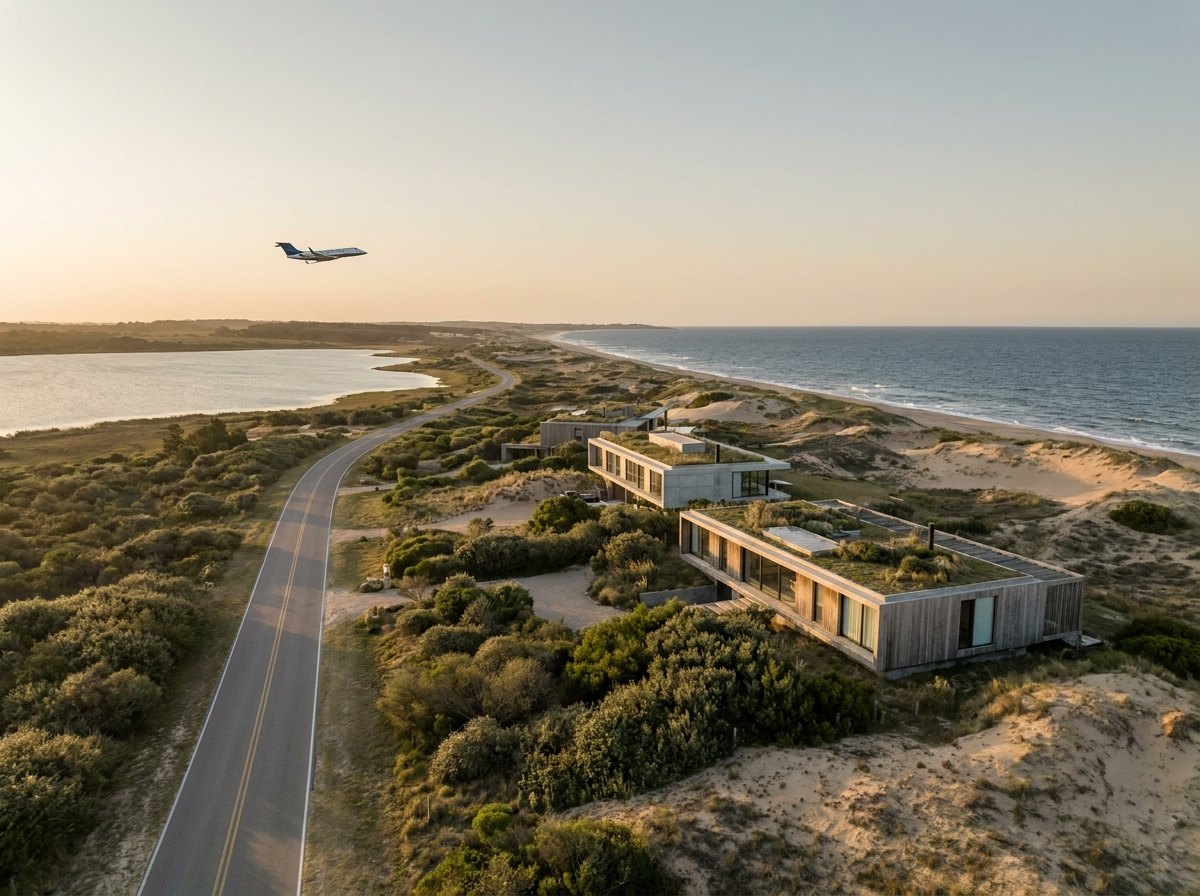
The proposed Rocha airport is becoming a serious infrastructure story for investors in Uruguay’s eastern coast. It now has a legal framework, an identified concession model, reported land acquisition and an announced investment budget. Yet one major variable remains unresolved: Uruguay’s Environment Ministry has stated that the initially proposed location should be reconsidered.
Information verified as of 8 August 2026. “VIP airport” is an editorial shorthand rather than an official administrative classification. Published project details indicate an initial focus on international non-commercial flights, private aviation and charters.
Executive summary
- Article 107 of Uruguay’s Law No. 20,446 authorises the Executive Branch to expand the existing Laguna del Sauce concession so that the same concessionaire may build, maintain and operate an airport in the department of Rocha.
- Published plans describe a runway of approximately 1,350 metres, extendable to 1,600 metres, a small terminal for roughly 50 passengers and an initial estimate of around 2,000 passengers and 1,000 aircraft movements per year.
- Rocha officials have described the initial market as international non-commercial traffic, particularly private flights and charters, with José Ignacio and western Rocha among the key demand areas.
- According to local media reports, Aeropuertos Uruguay acquired approximately 209 hectares at Route 10 and Camino al Caracol. Total planned investment has been reported at around US$40 million including land.
- The site is not final. On 6 August 2026, Environment Minister Edgardo Ortuño said his ministry’s technical services believe another location should be sought because the proposed area lies between two protected zones with significant biodiversity.
- For real estate investors, the more resilient thesis is therefore not “buy next to the announced runway”. It is to identify assets that can benefit from a broader integration of Punta del Este, José Ignacio and Rocha even if the final airport site moves.
A project with a genuine legal foundation
The most important distinction for investors is between a political announcement and an infrastructure project with a legal mechanism behind it. Rocha has moved into the second category.
Article 107 of Law No. 20,446 empowers Uruguay’s Executive Branch to broaden the scope of the existing concession for the Capitán de Corbeta Carlos A. Curbelo International Airport at Laguna del Sauce, allowing the same concessionaire to construct, maintain and operate an airport in the department of Rocha.
In return, the Laguna del Sauce concession may be extended by up to twenty-five years beyond its current term. The law makes that extension conditional on a properly supported technical and economic assessment and on the full and timely completion of the Rocha airport works and committed investment.
This is substantial, but it is not the same as a final construction permit. The legal concession framework exists; environmental, territorial and technical approvals remain separate issues.
Why the “VIP airport” description is directionally accurate
The project’s scale tells much of the story. Publicly reported specifications include an initial runway of about 1,350 metres with a possible extension to 1,600 metres, a compact passenger terminal for around 50 people and relatively modest initial traffic assumptions.
Rocha’s authorities have publicly said the airport would initially receive international flights that are not scheduled commercial services, particularly private and charter operations. Tourism officials have also linked the project to a highly selective visitor profile and to potential new hospitality investment.
That makes the airport economically different from a mass-market terminal. Its potential value lies less in passenger volume than in reducing door-to-door travel time for high-spending international users.
The “Uruguayan Riviera”: an investment thesis, not an official region
Punta Select Club uses the term “Uruguayan Riviera” as an investment and destination concept. It is not an official administrative designation. It describes the gradual integration of Punta del Este, La Barra, Manantiales, José Ignacio, Laguna Garzón and selected parts of Rocha into a broader premium residential and tourism corridor.
Punta del Este is the established anchor. José Ignacio extended the market eastward through a lower-density model built around privacy, landscape, gastronomy and scarcity. The next question is whether internationally mobile demand can move meaningfully beyond Laguna Garzón into Rocha.
A dedicated private-aviation gateway could accelerate that transition by removing one of the practical disadvantages of a more remote luxury location: transfer time after landing.
Five ways the airport could support real estate revaluation
1. Lower access friction
For international second-home owners, travel time is part of the asset experience. Easier access can make shorter and more frequent stays practical, increasing the utility of a residence even before considering price appreciation.
2. A deeper HNWI buyer pool
Rocha does not need mass aviation to create economic impact. A relatively small number of affluent visitors and owners can support premium residential projects, boutique hospitality and high-value local services.
3. An expanded José Ignacio catchment
As established micro-markets become scarce and expensive, demand can move into adjoining areas that offer comparable landscape, privacy and design potential. Western Rocha is one of the few places where that geographic continuity exists.
4. Hospitality and service infrastructure
Local tourism authorities have explicitly linked the airport with potential hotel development. Additional demand could also support private transport, property services, wellness, gastronomy and experiential tourism.
5. Land repricing through expectations
Land markets often react before infrastructure is delivered. This creates upside for early buyers but also a classic investment risk: paying today for an airport location or timetable that may later change.
The 209-hectare land acquisition: a strong signal, not a universal comparable
Local reporting in July 2026 stated that Aeropuertos Uruguay acquired cadastral plots 69,929 and 69,930 at Route 10 and Camino al Caracol, together covering around 209 hectares.
The reported land price was approximately US$40,000 to US$45,000 per hectare, implying around US$8.3 million to US$9.4 million for the land. Total investment for construction and commissioning has been reported at approximately US$40 million, including the acquisition.
For property investors this is a meaningful corporate commitment, but it should not be used as a direct benchmark for neighbouring rural land. An airport parcel carries unique value related to scale, flatness, access and operational suitability.
The planning story predates the airport
A particularly important point for a long-term real estate thesis is found in Rocha’s Lagunas Costeras Local Plan. The plan already identifies an area northwest of Route 10 as a “Potential Tourism Development Zone”, including the northern sector of Las Garzas, with predominantly large parcels and scope for tourism and service projects through the applicable planning instruments.
It also identifies bands alongside certain access roads as potentially transformable areas suitable for tourism-related investment because of their accessibility to the principal road structure.
This does not make every rural parcel development-ready. “Potentially transformable” is a planning attribute, not an automatic building right. The local plan is also undergoing a partial revision. Parcel-level due diligence is therefore essential.
The August 2026 turning point: the airport may proceed, but perhaps somewhere else
The environmental issue is now the project’s most important uncertainty.
On 6 August 2026, Environment Minister Edgardo Ortuño said his ministry’s technical services believe another location should be found and that he shares that view. The proposed site lies between Laguna Garzón and Laguna de Rocha, two environmentally sensitive protected areas with significant biodiversity and bird movement.
Laguna Garzón forms part of Uruguay’s National System of Protected Areas and is internationally relevant for bird conservation, including migratory species.
For investors, the correct framework is to separate airport probability from site probability. The existence of a concession mechanism and private capital behind the project does not mean the Route 10 location is fixed.
Why relocation would not necessarily weaken the wider Riviera thesis
If the airport moved inland, the distribution of benefits would change rather than disappear. A site closer to Route 9 could improve the relationship with Rocha city, the coastal access roads and La Paloma while still providing an additional executive-aviation gateway for eastern Uruguay.
This matters because Route 9 is itself undergoing major improvement. Uruguay’s Presidency has described a broader rehabilitation and dual-carriageway programme covering roughly 104 kilometres between Pan de Azúcar and the entrance to Rocha, with total investment of approximately US$158 million.
Infrastructure therefore needs to be read as a network: airport, Route 9, Route 10 and the east-west coastal market reinforce one another.
Where could the real estate impact be strongest?
| Area | Investment logic | Airport sensitivity |
|---|---|---|
| José Ignacio | Established premium market with potential liquidity and accessibility benefits. | Moderate: its value proposition does not depend on the project. |
| Laguna Garzón / El Caracol | Natural eastward continuation of José Ignacio with low-density positioning. | High, together with significant environmental constraints. |
| Las Garzas / north of Route 10 | Direct exposure to the initial site and existing tourism-development planning logic. | Very high; aircraft paths and noise could also become negatives. |
| Route 10–Route 9 connectors | Multiple drivers: coast, road access and relocation optionality. | High but diversified. |
| Rocha / Route 9 | Could gain materially if the airport is moved inland. | High under the relocation scenario. |
| La Paloma and the eastern coast | Longer-term halo from improved international accessibility. | Lower in the first phase. |
The international lesson: airports multiply fundamentals, they do not replace them
Private aviation access can be extremely valuable in an established luxury destination, but an airport alone does not create a premium property market. Sustainable value still requires scarcity, attractive landscapes, high-quality development, legal certainty, services and recurring international demand.
Eastern Uruguay already has a major advantage: the premium ecosystem exists. Punta del Este and José Ignacio have built international recognition over decades. Rocha’s opportunity is therefore not to invent a new market from zero, but to become the next logical extension of an existing one.
How investors should position before the final airport decision
The most robust strategy is to acquire optionality rather than pure speculation.
- Prefer assets with a clear legal access route and strong connectivity to Route 10, Route 9 or both.
- Verify drainage, elevation, wetland exposure and environmental constraints before valuing development potential.
- Demand a price that can be justified without assuming that the airport will be built next door.
- Confirm the parcel’s current planning category and the status of the Lagunas Costeras plan revision.
- Consider potential aircraft approach paths and noise, not only distance to the runway.
- Favour assets with a current use case and a second layer of upside if the wider premium corridor develops.
Key risks
Location risk
The Route 10 / Camino al Caracol location should no longer be treated as settled after the Environment Ministry’s August position.
Environmental risk
The region’s ecological quality is both an asset and a constraint. Protected areas, wetlands and bird corridors can materially affect what can be built and operated.
Planning risk
A potentially transformable rural designation is not an automatic right to subdivide or develop. Rules must be checked at parcel level.
Timing risk
Environmental and planning procedures can delay delivery or force significant redesign.
Pricing risk
Sellers may capitalise future infrastructure into asking prices before the infrastructure itself is secured.
Conclusion: Rocha could move from “beyond José Ignacio” to part of the same market
The strategic significance of Rocha Airport is not the initial passenger count. It is the type of traveller the airport is designed to serve and the geography it could compress.
If an environmentally viable location is agreed and the project is delivered, Uruguay’s eastern coast would gain another international gateway for private and charter aviation. That could strengthen José Ignacio, support more sophisticated hospitality in Rocha and make the west of the department easier to perceive as part of the same premium destination ecosystem.
The “Uruguayan Riviera” remains an investment thesis rather than an official label or a promise of returns. Yet the convergence of private capital, road investment, tourism-oriented planning and a new aviation project gives that thesis more substance than it had only a few years ago.
For Punta Select Club investors, the objective should not be to guess the exact runway location. It should be to identify assets with defensible present value and meaningful upside if the coastal premium corridor continues to expand eastward.
FAQ — Rocha Airport and Real Estate Investment
Is Rocha Airport definitely approved?
No. Uruguay has created a legal mechanism allowing the existing Laguna del Sauce concessionaire to build, maintain and operate an airport in Rocha, but the project still requires the relevant environmental, territorial and technical approvals. The originally proposed location is also under review.
Will Rocha Airport be a commercial airport or a private-jet airport?
Current public descriptions point to an initial focus on international non-commercial flights, private aviation and charters. Its small terminal and projected passenger volumes are consistent with an executive-aviation model rather than a mass commercial airport.
Where is the proposed airport site?
The site acquired by Aeropuertos Uruguay is reported to be at Route 10 and Camino al Caracol between Laguna Garzón and Laguna de Rocha. However, Uruguay’s Environment Minister said on 6 August 2026 that another location should be sought, so the site is not final.
Why does the project matter for José Ignacio?
Rocha officials have explicitly described the airport as an alternative access point for the high-end tourism market and for José Ignacio. Shorter ground transfers can make second homes and short stays more convenient for private-aviation users.
Which areas could benefit most from the airport?
Under the initial location scenario, Laguna Garzón, El Caracol, Las Garzas and the Route 10–Route 9 corridors have the strongest direct exposure. If the airport moves inland, Rocha city, Route 9 and access routes toward La Paloma could become relatively more important.
Does the airport guarantee property price appreciation?
No. Infrastructure can support demand and accessibility but cannot guarantee price increases. Land-use rules, environmental constraints, product quality, supply, buyer depth and the broader economic cycle remain critical.
What does “potentially transformable” rural land mean?
It means planning instruments may allow a future change in land category or use under defined procedures. It does not mean the land is already approved for subdivision or construction.
What is Punta Select Club’s role?
Punta Select Club provides market education, selected access to certain opportunities and buyer coordination for international investors. Where regulated legal, tax, technical or real estate services are required, the Club facilitates introductions through authorised local partners.
Sources
- IMPO — Law No. 20,446, Article 107
- Teledoce — Environment Ministry position on the airport location, 6 August 2026
- UyPress — Announced investment, private/charter orientation and tourism implications, 3 August 2026
- InfoRocha / reporting attributed to Búsqueda — Land acquisition and reported pricing
- Rocha Department — Lagunas Costeras Local Territorial Plan, Decree 1/2011
- Rocha Department — Partial revision of the Lagunas Costeras Local Plan
- Presidency of Uruguay — Route 9 dual-carriageway and rehabilitation programme
- Ministry of Environment — Laguna Garzón protected area
- Aeropuertos Uruguay — Institutional information
Approach the next phase of Uruguay’s east coast with structured due diligence
Would you like to compare specific areas between José Ignacio and Rocha, review a development or land parcel, or understand which locations may benefit from the next infrastructure cycle?
Punta Select Club provides international investors with a structured first point of entry into Uruguay, private market orientation and selected access to selected opportunities. When a project requires regulated legal, tax, technical or real estate services, we coordinate introductions through authorised local partners.
Disclaimer
This article is published for informational and educational purposes only. The information reflects sources and data available as of the editorial verification date of 8 August 2026. The Rocha airport project, its location, specifications, timetable, planning rules, public policies, tax rules and market conditions may change.
Any reference to revaluation, economic impact or future real estate scenarios is prospective analysis and not a guarantee of performance. Information concerning a specific property or investment should be independently verified before any decision is made.
This content does not constitute legal, tax, financial, wealth-management or real estate advice, nor a recommendation to buy or sell any asset. Each situation requires advice from appropriately qualified and, where required, authorised professionals.
Punta Select Club acts as a market-orientation and buyer-coordination platform and facilitates introductions through authorised local partners.