More than 150 business leaders, investors, public officials and institutional representatives gathered in Rio de Janeiro on 11 August 2026 for another edition of Uruguay Day in Brazil.
The event itself is not the most important part of the story.
The numbers behind it are.
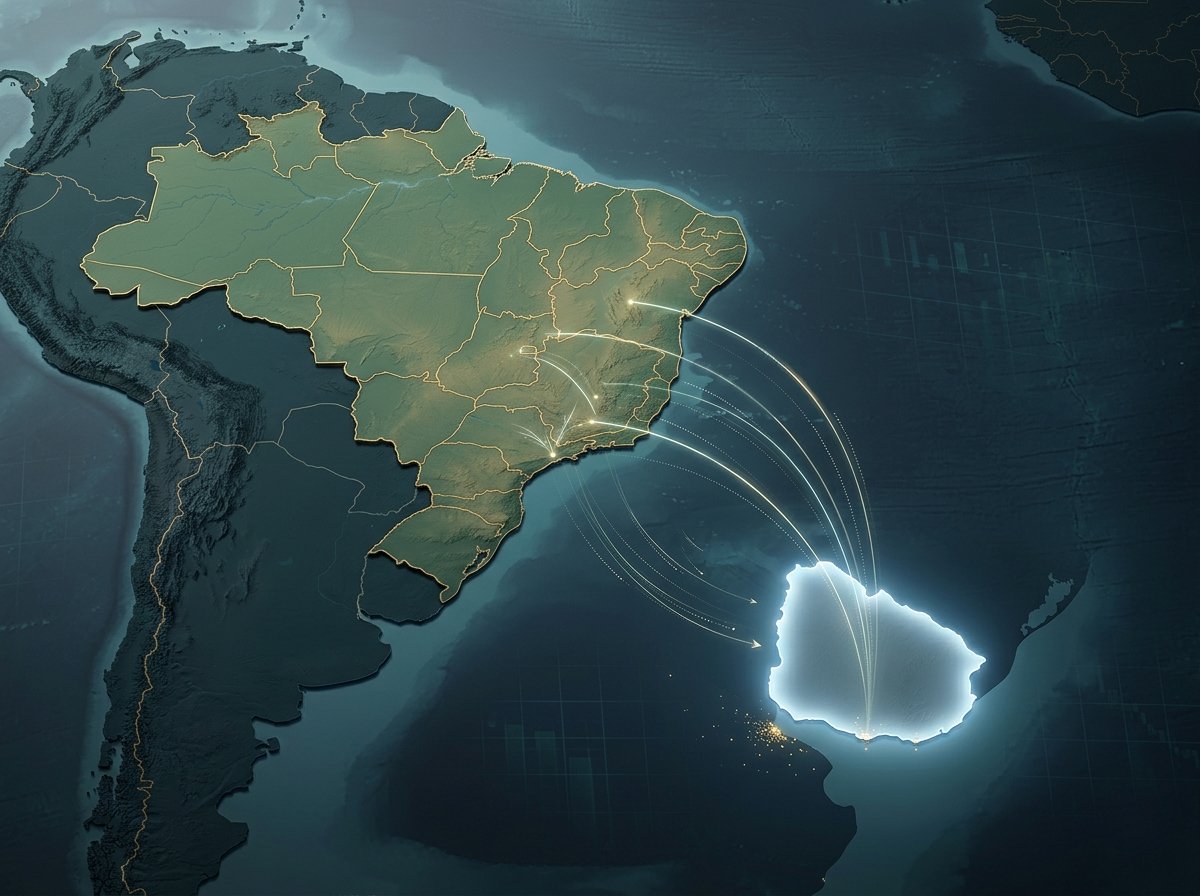
Since 2024, Brazil has been the leading source of investment enquiries received by Uruguay XXI, Uruguay’s investment, export and country-brand promotion agency.
Brazilian foreign direct investment stock in Uruguay stands at approximately US$4.4 billion. More than 100 Brazilian-owned companies already operate in the country and bilateral trade amounts to roughly US$5 billion a year.
The market perception data presented in Rio adds another signal: 76% of respondents surveyed in Rio de Janeiro said they would consider investing in Uruguay.
For international investors, this is more than a bilateral business story. It illustrates a broader shift in the way internationally mobile companies and families think about geography: predictability, optionality and jurisdictional diversification are becoming strategic assets in their own right.
Executive summary
- Brazil has been the leading source of investment enquiries received by Uruguay XXI since 2024.
- Brazilian FDI stock in Uruguay is approximately US$4.4 billion.
- More than 100 Brazilian-owned companies operate in sectors ranging from agribusiness and infrastructure to financial services, technology and tourism.
- Bilateral trade is approximately US$5 billion per year.
- In the study presented in Rio, 76% of local respondents said they would consider investing in Uruguay.
- Brazilian companies already operating in Uruguay repeatedly highlight legal certainty, institutional stability and long-term predictability rather than taxation alone.
- The trend may eventually support international demand in Punta del Este and Maldonado, but corporate FDI should never be confused with residential property investment or future price appreciation.
Why the Rio event matters
Uruguay Day should be read as one element within a broader investment relationship rather than as a standalone promotional event.
Earlier in 2026, Uruguay XXI hosted Brazilian executives and investors in São Paulo, including representatives of Pátria Investimentos and Marfrig, two groups with direct experience of operating from Uruguay.
Their comments help explain why the relationship is gaining depth.
Tax considerations can matter, but long-duration investors often care about something less spectacular and more fundamental: whether the rules governing an investment are likely to remain understandable and reasonably consistent throughout its life cycle.
Pátria described long-term predictability as an important element after evaluating multiple jurisdictions for regional activities. Marfrig noted that Uruguay was the first foreign market selected during its expansion beyond Brazil.
Individual corporate experiences should not be treated as universal evidence. They nevertheless demonstrate that Brazilian interest in Uruguay already extends well beyond enquiries and promotional campaigns.
Foreign investment is structurally important to Uruguay
Uruguay’s overall investment profile provides useful context.
According to Uruguay XXI, the country’s total FDI stock reached US$36.8 billion in 2024, equivalent to approximately 45% of GDP.
Nearly 60 foreign investment project announcements were recorded during that year, with activity across global services and technology, logistics, industry, agribusiness, renewable energy and the energy transition.
International capital is therefore not a marginal component of the Uruguayan economy.
Uruguay XXI describes the investment framework as offering equal treatment to domestic and foreign investors, free repatriation of capital and a range of investment incentives whose availability and impact depend on the specific project and activity.
Why Uruguay can make strategic sense for Brazilian capital
Geographic proximity without identical jurisdictional exposure
For Brazilian entrepreneurs and families, Uruguay offers an unusual combination.
It is geographically close, commercially integrated with Brazil and part of Mercosur, while remaining a separate legal, regulatory, fiscal and political jurisdiction.
This allows an investor to diversify internationally without necessarily moving operations thousands of kilometres away from the core Brazilian market.
The practical decision is therefore not always Brazil versus Uruguay. In many cases, it may be Brazil and Uruguay.
Predictability as an economic asset
The word repeatedly used by businesses and public officials during the 2026 investment events is predictability.
For investors with ten- or fifteen-year horizons, the expected return of an asset is only one part of the equation. Contract enforcement, institutional continuity and the ability to plan across several political administrations can materially influence the value of an investment environment.
This matters particularly in infrastructure, private equity, real estate, agribusiness and other long-duration projects.
A regional operating platform
Uruguay XXI increasingly presents the country as a platform for regional services, distribution, innovation and corporate functions.
For a Brazilian company, this does not necessarily involve transferring its main business away from Brazil.
It can instead mean maintaining Brazil as the core commercial market while establishing a complementary base in Uruguay for selected regional activities.
Recognised investment frameworks
Uruguay’s Free Zone regime and Investment Promotion Law are among the mechanisms commonly presented to international businesses.
Their potential benefits should not be generalised. Eligibility, tax consequences and economic value depend on the underlying activity, legal structure, substance and the rules applicable in every jurisdiction connected to the investor.
Private wealth mobility points in the same direction
The corporate investment story becomes more significant when viewed alongside private wealth mobility data.
The Henley Private Wealth Migration Report 2026 gives Uruguay a Wealth Mobility Competitiveness Score of 71.8 out of 100, compared with 64.2 for Brazil.
This metric must be interpreted carefully.
Henley expressly states that the score is not a measure of actual millionaire inflows or outflows. It assesses structural factors affecting the relative attractiveness of jurisdictions to internationally mobile individuals, families and capital, including taxation, rule of law, quality of life, residence pathways, geopolitical stability and capital mobility.
Visual Capitalist’s ordering of the Henley scores places Uruguay ninth among the 29 jurisdictions shown in its July 2026 visualization. That presentation is useful for comparing scores, but it should not be read as a ranking of actual wealth migration flows.
Henley’s dedicated Latin American analysis goes further, identifying Uruguay as one of the region’s wealth-mobility anchors and referring specifically to Brazilian wealth seeking lower-volatility positioning.
A separate measure: investment risk and resilience
The Henley & Partners and AlphaGeo Global Investment Risk and Resilience Index provides a different analytical lens.
| Country | Global rank | Score / 100 |
|---|---|---|
| Uruguay | 34th | 69.28 |
| Brazil | 99th | 55.09 |
These figures should not be interpreted as proof that Uruguay is a superior destination for every investment.
Brazil has characteristics Uruguay cannot replicate: economic scale, deep domestic demand, larger capital markets, industrial capacity and substantially greater opportunities in many growth sectors.
The more useful interpretation is one of complementarity.
Brazil can remain a major market for growth and wealth creation while Uruguay serves as an additional jurisdiction for diversification, residence, selected investments or regional operations.
This distinction helps explain why sophisticated investors may use both countries rather than choose between them.
What could this mean for Punta del Este and Maldonado?
This is where careful analysis becomes essential.
The US$4.4 billion figure represents Brazilian foreign direct investment across multiple sectors of the Uruguayan economy. It does not represent US$4.4 billion of residential property purchases and should never be used as a proxy for housing demand in Punta del Este.
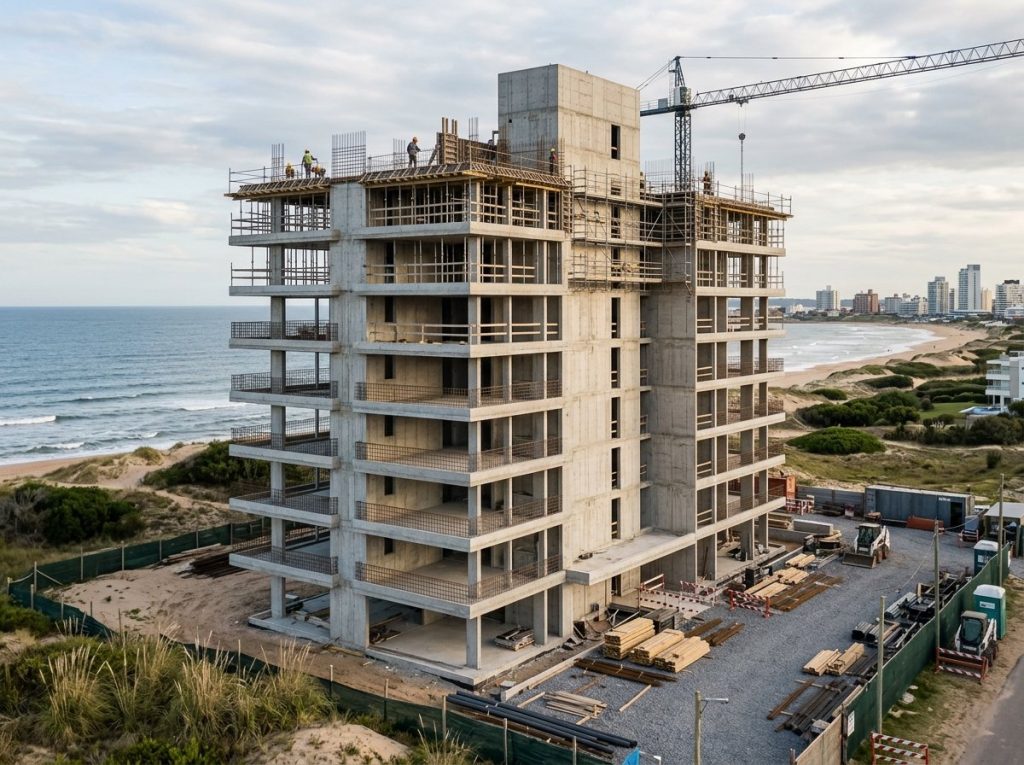
There are nevertheless several indirect channels through which stronger Brazil–Uruguay integration could become relevant to the coastal property market.
- more Brazilian entrepreneurs and senior executives developing activities in Uruguay;
- greater interest in second homes or regional family bases;
- increased tourism and familiarity with the country;
- private wealth diversification into real assets outside Brazil;
- international families seeking a combination of Montevideo business access and a premium coastal lifestyle.
Brazilian tourism is another useful indicator. Uruguay XXI reported that Brazilian arrivals increased by 4.4% in the first half of 2026 and accounted for approximately 12% of all international arrivals.
Again, none of this proves future property-price appreciation.
What it does suggest is that Brazilian exposure to Uruguay is developing simultaneously across corporate, tourism and private-wealth channels. For Punta del Este, that is a trend worth measuring over time.
Potential opportunities for international investors
Jurisdictional diversification
An investor already exposed to Brazil, Argentina, Europe or North America may view Uruguay as an additional jurisdiction rather than a replacement for existing positions.
Premium real estate
A broader international buyer base can improve the depth of selected markets. Yet returns will continue to depend on entry price, location, building quality, operating costs, genuine rental demand and resale liquidity.
Regional business operations
Uruguay may be relevant to certain businesses seeking a base for global services, technology, logistics, trade or export-oriented activities.
Private wealth optionality
International families increasingly separate the jurisdictions in which they live, hold investments, operate businesses or maintain banking relationships. Uruguay can potentially form one part of such a multi-jurisdiction strategy.
Risks that should not be overlooked
Institutional stability does not make an individual investment risk-free.
Uruguay is a relatively small economy. Certain asset classes may offer less market depth and lower exit liquidity than major global financial centres. Some goods and services are also comparatively expensive within the region.
In property investment, due diligence should include:
- actual transaction comparables and price per square metre;
- title and legal status;
- developer record and financial capacity for off-plan projects;
- planning approvals and environmental restrictions;
- hydrological and flood-risk analysis where relevant;
- building charges and maintenance costs;
- verifiable rental demand;
- realistic resale liquidity;
- tax treatment in Uruguay and in the owner’s country of tax residence.
Brazilian investors in particular should assess the Brazilian tax and reporting consequences of any Uruguayan structure. A favourable treatment in Uruguay does not automatically eliminate obligations in Brazil.
What investors should monitor next
The strongest confirmation of the trend will not come from promotional events. It will come from measurable activity.
Useful indicators include:
- the evolution of Brazilian investment enquiries handled by Uruguay XXI;
- new Brazilian corporate establishments;
- cross-border private equity and acquisition activity;
- Brazilian tourism flows;
- reliable data on foreign purchasers in Maldonado where available;
- growth in banking, legal and private-client infrastructure serving international families.
Monitoring these indicators will help distinguish a durable structural shift from temporary investor interest.
Conclusion: diversification rather than exodus
The Brazil–Uruguay investment story should not be framed as a Brazilian capital exodus. Nor does the available evidence suggest that Uruguay is replacing Brazil as an investment market.
The more important development is the growing sophistication of jurisdictional diversification.
Companies, investors and internationally mobile families increasingly ask not which single country they should choose, but which combination of countries gives them the strongest balance of opportunity, access, stability and optionality.
Within that framework, Uruguay has a particularly compelling relationship with Brazil. It is geographically close, commercially connected and institutionally distinct.
Brazil becoming the leading source of investment enquiries received by Uruguay XXI since 2024 is therefore a meaningful signal.
For Punta del Este and Maldonado, a deeper Brazilian presence across business, tourism and private wealth could progressively broaden the region’s international investor base.
But the discipline required of the individual buyer remains unchanged. A compelling national story can justify examining a market. It can never replace asset-level due diligence, appropriate pricing and qualified legal and tax advice.
FAQ – Brazilian Investors in Uruguay
Why are Brazilian investors increasingly interested in Uruguay?
Uruguay XXI and Brazilian companies already operating in the country point to geographic proximity, institutional stability, legal certainty, predictable rules and the possibility of using Uruguay as a platform for selected regional operations. Private investors may also consider residence, lifestyle and geographic diversification.
How much Brazilian investment is already in Uruguay?
Uruguay XXI reports Brazilian foreign direct investment stock of approximately US$4.4 billion. This represents investment across a range of businesses and economic sectors and should not be interpreted as residential property investment.
How many Brazilian companies operate in Uruguay?
More than 100 Brazilian-owned companies operate in Uruguay across sectors including industry, energy, agribusiness, services, infrastructure, technology, finance, retail and tourism.
Is Uruguay safer than Brazil for investors?
Some international resilience and wealth-mobility indicators currently score Uruguay more highly than Brazil. This does not mean every Uruguayan investment carries less risk. Brazil also offers materially greater scale, liquidity and growth opportunities. The countries can serve different roles within the same investment strategy.
Could Brazilian demand raise property prices in Punta del Este?
Sustained growth in Brazilian residential demand could contribute to stronger market conditions, but current FDI figures do not prove such an effect. Property prices depend on supply, project quality, construction costs, financing, rental demand and the behaviour of Uruguayan, Argentine, Brazilian and other international buyers.
Can foreign investors repatriate capital from Uruguay?
Uruguay XXI describes the country as allowing free repatriation of capital and equal treatment of domestic and foreign investors. Individual transactions remain subject to banking procedures, tax rules, source-of-funds requirements and anti-money-laundering compliance.
Do Brazilian investors automatically qualify for Uruguayan tax incentives?
No. Tax treatment depends on the activity, structure, residence position and applicable regime. Brazilian tax and reporting obligations must also be assessed independently. Investors should obtain qualified advice in every relevant jurisdiction before implementing a structure.
Sources
- Uruguay XXI — Uruguay Day in Rio Brings Together More Than 150 Business and Government Leaders, August 2026
- Uruguay XXI — Foreign Direct Investment in Uruguay 2025
- Uruguay XXI — Growing interest from Brazilian companies in Uruguay as a hub for business and innovation, May 2026
- Uruguay XXI — Brazilian companies highlight Uruguay as a reliable platform for long-term investment and regional expansion, May 2026
- Henley & Partners — Private Wealth Migration Report 2026
- Henley & Partners — Latin American Wealth Mobility Anchors 2026
- Henley & Partners / AlphaGeo — Global Investment Risk and Resilience Index, May 2026 update
- Visual Capitalist — The World’s Top Destinations for Wealth Migration, July 2026
Considering investment or diversification in Uruguay?
Punta Select Club provides a structured first point of entry for international investors seeking to understand the Uruguayan market, Punta del Este and the practical stages involved in a potential acquisition or relocation project.
Our role is to provide market orientation, buyer-side coordination and, where appropriate, introductions through authorized local partners.
Disclaimer
This article is published for informational and educational purposes only. The information, figures and analysis reflect data available and verified as of 17 August 2026. Markets, regulations, tax regimes, public policy, investment incentives and residence rules may change.
Nothing in this article constitutes legal, tax, financial, wealth-management, real-estate or investment advice, nor a recommendation to buy, sell or hold any asset. Historical trends, rankings, scores and statistics do not guarantee future outcomes.
Any investment, relocation, tax-residence or property-acquisition decision should be independently verified and assessed with appropriately qualified and licensed professionals in every relevant jurisdiction.
Punta Select Club operates as an information, market-orientation, buyer-coordination and introduction agency working with authorized local partners.