For decades, the rental-property story in Punta del Este was dominated by one idea: acquire an apartment, monetise the peak summer season and accept a much quieter market during the rest of the year.
That description is increasingly incomplete. Demographic data, residency statistics and official tourism figures now point to a broader structural change: Punta del Este is attracting both a larger permanent resident base and international visitors who stay for longer periods.
For an international investor, this does not mean that every apartment becomes a good investment. It means that some carefully selected properties can increasingly be analysed against several layers of demand — short-term tourism, medium-term accommodation and year-round residential leasing — rather than relying almost entirely on January and February.
Executive summary
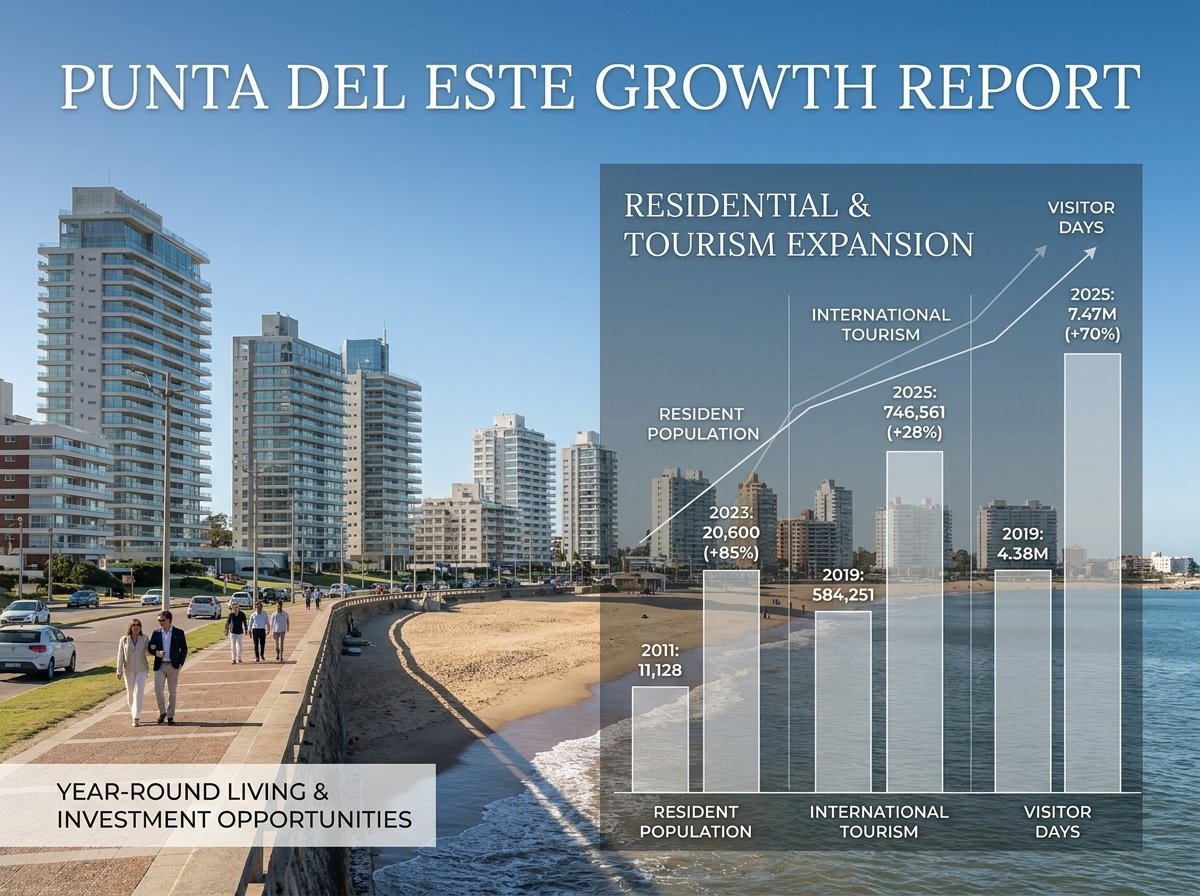
- Punta del Este municipality had 11,128 residents in 2011 and 20,600 in 2023, an increase of roughly 85%.
- Over the same period, Maldonado department grew by approximately 24%, meaning Punta del Este expanded far more rapidly than the department as a whole.
- Residency procedures initiated in Punta del Este increased from 272 in 2020 to close to 900 per year by 2025, according to Uruguay’s National Migration authority.
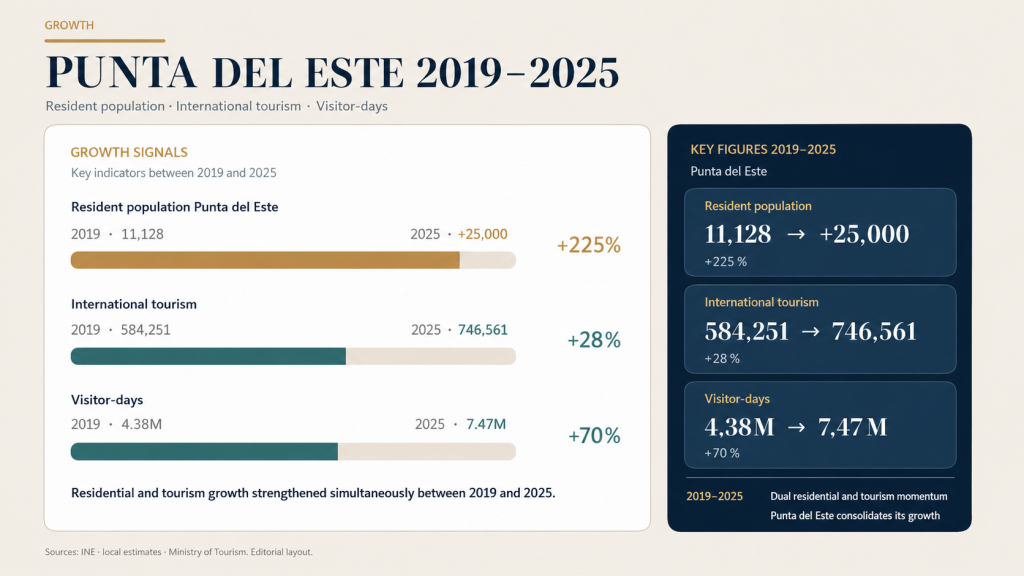
- Punta del Este received 746,561 international visitors in 2025, compared with 584,251 in 2019.
- Average stay increased from 7.5 days in 2019 to 10 days in 2025.
- Estimated aggregate visitor presence rose from approximately 4.38 million to 7.47 million visitor-days, close to +70%.
- In 2025 Punta del Este accounted for around 20.7% of Uruguay’s inbound visitors but close to 45% of inbound tourism expenditure.
- The investment case is therefore broader, but returns remain highly dependent on acquisition price, operating costs, location, regulation and property quality.
Context: Punta del Este is becoming a more year-round city
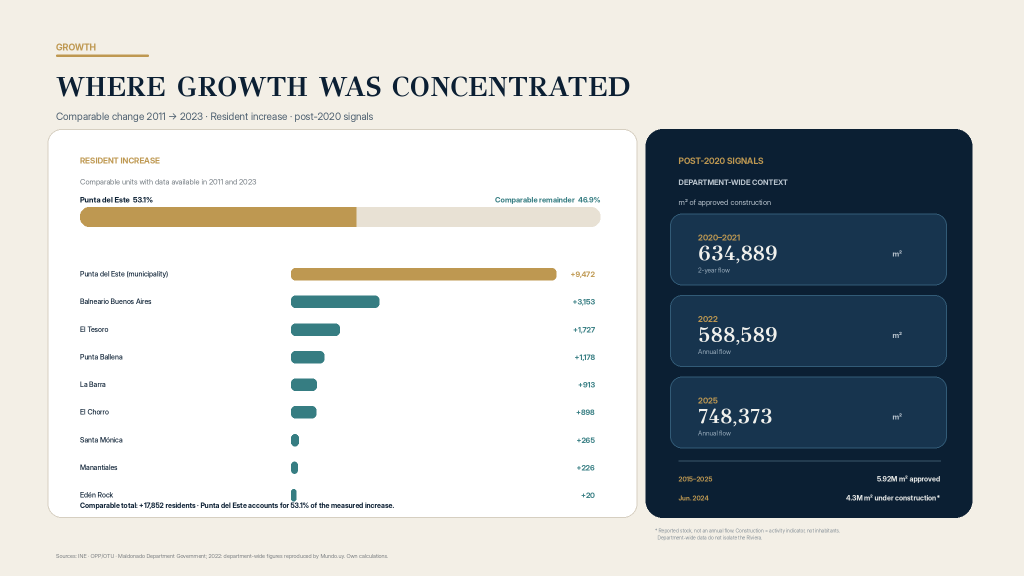
The first structural change is demographic. Observatorio Territorio Uruguay recorded 11,128 inhabitants in Punta del Este municipality in 2011. The weighted 2023 Census places the municipal population at 20,600.
This roughly 85% increase stands in sharp contrast with Maldonado department as a whole. Punta del Este is therefore not merely following wider departmental growth; it appears to be capturing an unusually strong residential dynamic of its own.
In early 2024, La Nación cited a professional estimate of approximately 25,000 people active in Punta del Este throughout the year. This is not an official census figure and should not be directly compared with the INE municipal boundary, but it is a useful indicator of the destination’s functional year-round population.
Demographic analysis: the post-2020 acceleration
Residency administration provides another important signal. When a larger Residency Office opened in Punta del Este in February 2025, Uruguay’s National Migration authority stated that 272 procedures had been initiated locally in 2020, compared with close to 900 per year five years later.
A residency file is not identical to one net additional permanent resident, but the more than threefold increase is a strong indicator of relocation activity.
Academic research published in 2025 on the Maldonado–Punta del Este urban area also describes a residential turn driven by quality of life, remote work, retirement, stability, entrepreneurship and access to services. These profiles can generate demand for temporary accommodation, medium-term leases and annual rentals.
The Uruguayan Riviera as an investment corridor
In this article, Uruguayan Riviera is an editorial and market term for the coastal corridor running approximately from Punta Ballena to José Ignacio through Punta del Este, La Barra, Manantiales, El Chorro, Balneario Buenos Aires and La Juanita. It is not an official administrative area.
Census 2023 confirms a growing permanent resident base across several of these localities. Yet each micro-market retains a distinct price structure, tourism profile, level of year-round services and resale liquidity. Geographic continuity should not be confused with investment homogeneity.
Tourism analysis: fifteen years of cycles
| Year | International visitors | Interpretation |
| 2011 | 688,540 | Strong regional demand |
| 2014 | More than 570,000 | Down cycle |
| 2017 | ≈829,000 | Recent peak |
| 2019 | 584,251 | Significant decline before Covid |
| 2020–2021 | COVID-19 pandemic | Border closures and survey disruption |
| 2022 | 539,287 | Recovery |
| 2023 | 691,490 | Strong rebound |
| 2024 | 647,839 | Normalisation |
| 2025 | 746,561 | Renewed growth |
2025 was therefore not an all-time record for international arrivals. The exceptional 2017 level remained higher. The more important transformation lies in how long visitors stay.
The decisive variable: longer stays
| Year | Visitors | Average stay | Estimated visitor-days |
| 2019 | 584,251 | 7.5 days | ≈4.38 million |
| 2022 | 539,287 | 8.6 days | ≈4.64 million |
| 2023 | 691,490 | 8.5 days | ≈5.88 million |
| 2024 | 647,839 | 9.1 days | ≈5.90 million |
| 2025 | 746,561 | 10 days | ≈7.47 million |
Visitor-days are calculations derived from official visitor and average-stay figures. Between 2019 and 2025, arrivals increased by about 28% while aggregate visitor presence rose by roughly 225%. For a rental market, nights of potential occupancy can matter more than the number of border entries.
An outsized share of national tourism expenditure
International visitors whose main destination was Punta del Este spent approximately USD 918.4 million in 2025. Uruguay as a whole received roughly 3.60 million inbound visitors generating close to USD 2.04 billion.
Punta del Este therefore represented about 20.7% of inbound visitors and close to 45% of inbound tourism expenditure. This supports the destination’s premium positioning, but total tourism spending must not be confused with rental income.
Consequences for the rental market
The central shift is the coexistence of two demand engines.
Tourism demand
Seasonality remains significant, but longer stays, events, weekends and stronger shoulder-season activity broaden the potential rental calendar.
Residential demand
A larger resident base can generate annual leases, temporary relocation demand and medium-term housing for professionals, families, retirees and prospective buyers.
A property capable of serving more than one profile may offer greater strategic flexibility. That optionality is more important than a single theoretical yield presented as certain.
Opportunities: three rental strategies to model separately
Short-term tourism
This model can capture high peak-season rates but requires more active management, guest turnover, cleaning, marketing and vacancy control.
Medium-term accommodation
Multi-week or multi-month stays can suit relocating families, remote workers, executives and prospective buyers testing a location before purchasing.
Annual residential leasing
This can provide greater cash-flow visibility and lower operating intensity. Punta del Este’s larger permanent population makes this strategy more relevant than it was when the city functioned primarily as a seasonal resort.
What makes an apartment more resilient across seasons?
- disciplined acquisition price;
- sustainable condominium fees;
- proximity to year-round shops and services;
- walkability and accessibility;
- heating and air conditioning suitable for winter;
- parking;
- good natural light and orientation;
- building rules compatible with the intended rental use;
- controlled management and maintenance costs;
- future resale liquidity.
A highly amenitised building can be commercially attractive but may produce weaker net results if fixed charges absorb too much of the rental income.
International comparison: a premium destination with a distinctive structure
Punta del Este shares characteristics with other international second-home destinations: foreign buyers, leisure-driven demand, seasonality and quality-of-life appeal. Direct comparisons with Mediterranean, North American or Caribbean markets should nevertheless be made cautiously.
Its distinctive features include the importance of regional visitors, the historical weight of second homes, widespread use of the US dollar in real-estate transactions and the rapid recent expansion of a year-round resident population.
Risks
- large existing stock of temporary and second-home properties;
- new construction can increase competition;
- high condominium fees in some premium buildings;
- significant exposure to Argentine demand;
- regional exchange-rate sensitivity;
- large performance differences between micro-locations.
Regulatory points to verify
Uruguay’s Law No. 20.352 establishes a framework for tourist accommodation in residential properties and includes registration obligations. The Ministry of Tourism continued implementation work in 2025, including registration mechanisms and greater integration of digital platforms.
Before acquiring a property for rental use, investors should verify building rules, national and departmental requirements, tax treatment, registration procedures and any reporting obligations in force at the time of operation.
2026: a useful warning against straight-line forecasts
During the first quarter of 2026, Punta del Este received 333,276 international visitors, below the same period of 2025. Average stay nevertheless increased to 12.1 days and expenditure reached approximately USD 464.4 million.
The message is important: a positive structural transformation can coexist with weaker quarters. The market remains exposed to regional economics, exchange rates, connectivity and traveller behaviour.
Conclusion
Punta del Este is changing scale. Its municipal population has nearly doubled since 2011, residency activity accelerated after 2020 and the wider coastal corridor supports more year-round life. At the same time, international visitors are staying longer and generating a very large share of Uruguay’s inbound tourism expenditure.
For investors, the conclusion is not to buy any apartment in Punta del Este. It is to identify assets whose acquisition price, location, operating costs and regulatory position allow them to benefit from a more diversified demand base. Property selection remains more important than any broad market narrative.
FAQ
How many permanent residents live in Punta del Este?
Punta del Este municipality had 20,600 residents in the weighted 2023 Census, compared with 11,128 in 2011.
How many international tourists visited Punta del Este in 2025?
Uruguay’s Ministry of Tourism recorded 746,561 international visitors whose principal destination was Punta del Este.
Is there rental demand outside summer?
The larger resident base and increased residency activity suggest broader year-round demand, although depth varies significantly by location, unit type and price point.
Can apartments be rented to tourists through digital platforms?
Tourist accommodation is regulated under Law No. 20.352 and its implementation rules. Building regulations, tax obligations and registration requirements must also be checked.
What does Uruguayan Riviera mean?
In this article it is an editorial term for the coastal corridor from approximately Punta Ballena to José Ignacio. It is not an official administrative area.
Does demographic growth guarantee property appreciation?
No. Population growth is only one factor. Supply, construction, exchange rates, regulation, liquidity and regional economic conditions also influence property values.
Sources
- Observatorio Territorio Uruguay — Punta del Este Municipality, Census 2011
- Uruguay National Statistics Institute — Weighted Census 2023
- Maldonado Government — Punta del Este Residency Office
- Población & Sociedad — research on the residential shift in Maldonado–Punta del Este
- La Nación — The New Punta del Este, January 2024
- Uruguay Ministry of Tourism — Inbound Tourism 2019
- Uruguay Ministry of Tourism — Inbound Tourism 2022
- Uruguay Ministry of Tourism — Inbound Tourism 2023
- Uruguay Ministry of Tourism — Inbound Tourism 2024
- Uruguay Ministry of Tourism — Inbound Tourism 2025
- Uruguay Ministry of Tourism — First Quarter 2026
- IMPO — Law No. 20.352
- Uruguay Ministry of Tourism — Tourist accommodation regulation
Call to Action
Would you like to understand the Punta del Este rental market more clearly, compare different areas of the Uruguayan Riviera or review a property opportunity from an international buyer’s perspective?
Punta Select Club provides a structured first point of entry for international investors, combining market orientation, selected access to selected opportunities and coordination with authorised local partners where required.
Disclaimer
This article is published solely for informational and educational purposes. Information reflects sources and knowledge available as of August 2026. Population figures can vary depending on geographic boundaries and methodological revisions by INE. Private estimates cited are not official population statistics. Visitor-day figures are calculations derived from visitor counts and average length of stay published by Uruguay’s Ministry of Tourism.
Regulation, taxation, public policy, tourist-rental rules and market conditions can change. All information should be independently verified before any purchase, rental or investment decision.
Nothing in this article constitutes legal, tax, financial, wealth-management or real-estate advice, an investment recommendation or a guarantee of rental income, occupancy or capital appreciation. Individual circumstances require advice from appropriately qualified and authorised professionals.
Punta Select Club operates as a private information, market-orientation, selected-access and coordination platform for international investors.