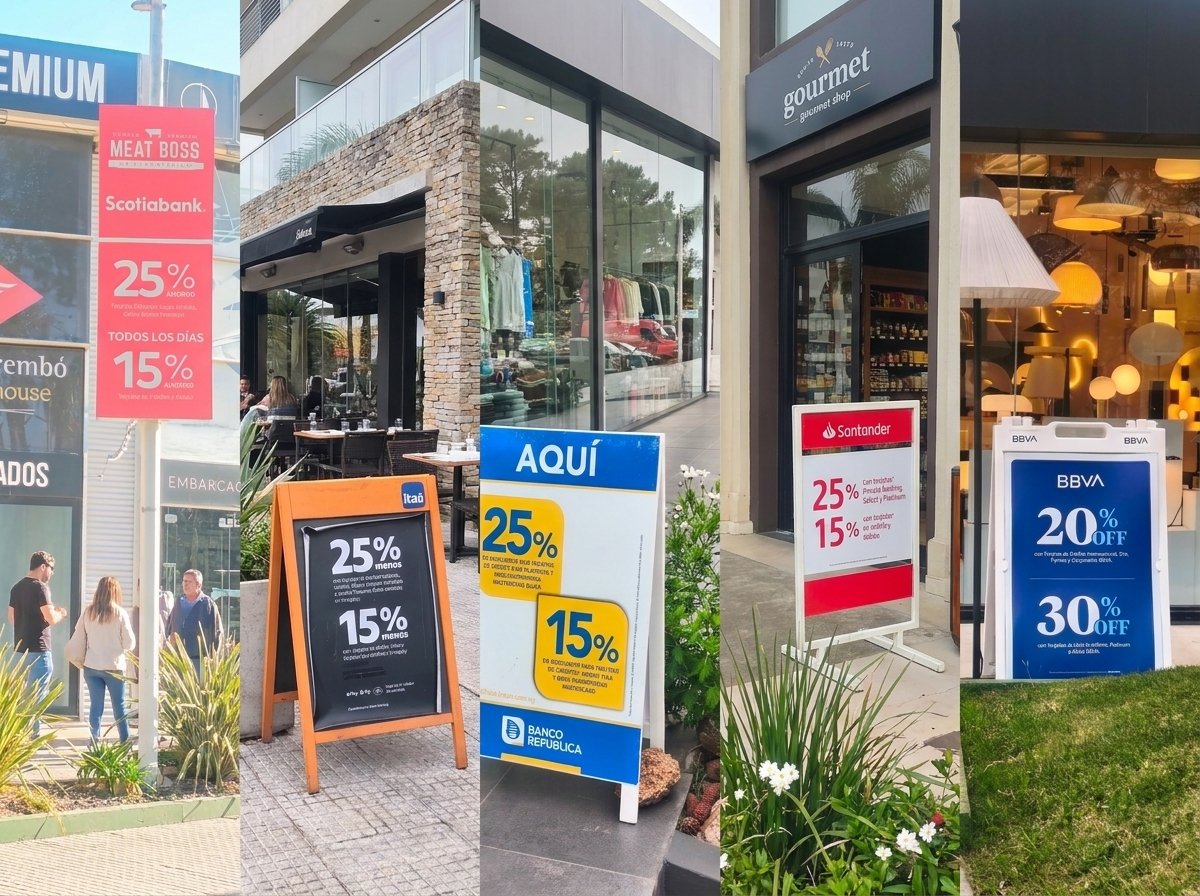
One of the first things an internationally mobile resident may notice in Punta del Este or Montevideo is not a tax rule or a property price, but the Uruguay bank discounts. They are signs outside a restaurant: 15% off with one bank, 25% with a premium card, sometimes 30% or more.
These are not merely loyalty points presented as a headline number. Major Uruguayan institutions publicly advertise substantial card-linked merchant benefits. Santander, Scotiabank, Itaú, BBVA and BROU all maintain highly visible programmes, while Bandes/Cabal and OCA also participate in the broader discount ecosystem.
The implication matters for anyone assessing Uruguay as a place to live, own property or base part of a family’s affairs. Uruguay’s nominal price level and the amount an informed local consumer ultimately pays can diverge. The country does not become inexpensive because of card promotions. But the net cost of selected recurring spending can be materially lower for someone who uses the local banking ecosystem well.
Executive summary
- Double-digit bank discounts are genuine where the cardholder meets the published eligibility rules.
- The benefit may be applied instantly, credited later to the statement or split between both mechanisms.
- Premium card tiers frequently receive higher discount percentages and, in some campaigns, higher caps.
- The issuing bank does not necessarily fund the entire headline discount; merchant and bank contributions depend on the underlying commercial agreement.
- Uruguay also has statutory VAT reductions for certain electronic payments. These are separate from bank promotions and should not be added arithmetically to the advertised card discount.
- For a high-spending resident, bank and card selection can become a meaningful part of annual household budgeting.
What the major programmes currently look like
The field photographs behind this article show Santander, BBVA, BROU, Itaú and Scotiabank promotions in Uruguay. The banks’ own benefit programmes confirm that these signs reflect a broader market structure rather than isolated one-off offers.
| Institution | Examples of publicly advertised benefits | Typical operating format |
|---|---|---|
| Santander Uruguay | Double-digit daily discounts across large partner networks, with higher benefits attached to selected premium packages. | Either point-of-sale discount or later statement credit depending on the campaign. |
| Scotiabank Uruguay | Hundreds of published benefits, with different savings levels depending on card tier. | Frequently deducted at purchase in the offers reviewed. |
| Itaú Uruguay | Restaurant and premium-partner benefits with higher percentages available to selected cardholders. | Immediate point-of-sale discounts are common in published campaigns. |
| BBVA Uruguay | Restaurant campaigns offering different rates for standard and premium cards, including 20% and 30% structures in certain promotions. | Depending on the campaign, the benefit may combine an immediate merchant reduction with a later bank reimbursement. |
| BROU | A broad benefits catalogue with double-digit promotions depending on merchant, card and campaign. | Varies by programme. |
| Bandes / Cabal | Targeted supermarket, leisure and merchant promotions. | Some benefits are credited after the transaction. |
| OCA | Regular rotating promotions across multiple retail categories. | Campaign-specific. OCA is a financial card issuer rather than a traditional retail bank. |
This table is a snapshot of the model, not a permanent tariff. Merchant lists, card tiers, percentages, caps and campaign dates change frequently.
How the discount actually reaches the customer
1. Immediate discount
The simplest structure is a direct merchant deduction. A UYU 8,000 restaurant bill with a genuine 25% point-of-sale benefit becomes UYU 6,000 at checkout.
2. Statement credit
In other campaigns, the customer pays the full amount, or almost the full amount, and receives a subsequent reimbursement on the card statement. The credit may appear several days or several weeks after the transaction and, depending on the bank, may sometimes be subject to a monthly cap or a maximum amount per statement cycle.
3. Hybrid structure
Some BBVA promotions provide a clear illustration of this architecture. A headline benefit can be divided between an amount deducted by the merchant at the point of sale and a later statement credit provided by the bank, sometimes subject to campaign-specific conditions.
This operational split is important, but it does not reveal the full commercial funding arrangement. The bank, merchant, acquiring chain and payment network may participate under private agreements. It would therefore be incorrect to assume that every headline percentage is paid entirely by the issuing bank.
Why would a bank provide substantial benefits to a wealthy client who never pays card interest?
Because revolving card interest is only one component of customer economics. A high-net-worth client who pays in full every month may still be commercially valuable through deposits, foreign-exchange flows, transfers, mortgages, insurance, investments and private-banking relationships, depending on the institution.
Card usage also creates behavioural loyalty. The card that gives a client a substantial benefit at restaurants, retail and leisure is more likely to become the card used first. Becoming the primary financial relationship can be worth considerably more to a bank than interest on a single credit-card balance.
The merchant has its own rationale. A large discount can be treated as a customer-acquisition cost: it channels a defined bank population into the business, improves frequency and may help fill unused capacity. In hospitality, for example, a discounted occupied table may be economically preferable to an empty table.
It is therefore too simplistic to assume that the bank automatically loses the entire advertised percentage. The benefit can be shared between participants and may generate an indirect return through customer loyalty and increased use of the broader banking relationship.
A second layer: Uruguay’s VAT reductions for electronic payments
Uruguay’s tax system adds a separate incentive. The Dirección General Impositiva provides VAT reductions for certain qualifying purchases made through eligible electronic payment methods.
A general reduction of two VAT percentage points applies to certain purchases paid with debit cards, electronic money or analogous instruments.
Specified services may also receive a larger VAT reduction when paid electronically, including qualifying gastronomic services and other categories defined by the relevant rules.
The distinction matters: a reduction expressed in VAT percentage points is not necessarily the same as an identical percentage discount on the gross bill. A bank promotion and a VAT reduction should therefore not be presented as if their headline figures could simply be added together.
What can this do to a household budget?
The system does not lower every expense. Rent, property taxes, school fees and many services may have no relevant card benefit at all. The meaningful question is how much of a household’s discretionary spending falls inside participating merchant networks.
| Monthly eligible spend | Hypothetical effective discount | Monthly saving | Theoretical annualised saving |
|---|---|---|---|
| UYU 40,000 | 15% | UYU 6,000 | UYU 72,000 |
| UYU 80,000 | 20% | UYU 16,000 | UYU 192,000 |
| UYU 120,000 | 20% | UYU 24,000 | UYU 288,000 |
These are not forecasts or promises. They simply show why a household that spends heavily on restaurants, retail, home, pharmacies and leisure may find that card selection has measurable financial value.
Why international residents and investors should care
People considering Uruguay often model housing, healthcare, schooling, transport, insurance and tax exposure. Payment infrastructure deserves a place in that analysis because it can affect day-to-day cash outflow.
A useful framework is to separate four numbers:
- the sticker price;
- the amount charged after any point-of-sale discount;
- the final net cost after statement credits and applicable tax benefits;
- the annual cost of maintaining the card or banking package.
For an affluent resident, holding more than one local card may be economically rational if the merchant networks complement one another. That should still be balanced against fees, onboarding requirements, KYC, approval standards and the practical value of keeping the financial structure simple.
Is Uruguay unique?
No. Argentina has a similarly strong bank-discount culture. US cardholders are familiar with targeted statement-credit offers, while European banks also run merchant offers and cashback programmes.
There is no credible global benchmark showing that Uruguay has the world’s highest card discounts. The more defensible observation is that the density, visibility and day-to-day relevance of double-digit bank discounts are unusually striking in Uruguay, particularly for such a small market.
Risks and practical checks
- Caps: some institutions impose monthly, per-cycle, per-merchant or per-customer limits.
- Exact card tier: standard, Gold, Platinum, Black, Infinite, Select and Private Banking products may receive different benefits.
- Payment channel: some campaigns exclude payment intermediaries or specific online channels.
- Dates: benefits may be daily, seasonal or limited to specific weekdays.
- Timing: a statement credit may arrive days or weeks after the purchase.
- Card fees: the annual or monthly package cost must be included in the economics.
- Borrowing cost: paying high revolving interest merely to earn a merchant discount is not rational budgeting.
- Eligibility: local banking and premium cards are subject to KYC, documentation, income or asset requirements and bank approval.
- Tax rules: VAT incentives are separate from bank promotions and can change.
Conclusion: in Uruguay, the payment method can be part of the price
Uruguay’s bank-benefit culture changes consumer behaviour because the payment method can materially alter the transaction price. A restaurant bill may genuinely have a lower net cost for a cardholder whose bank has a 15%, 20%, 25% or 30% agreement with that merchant.
This should not be turned into the simplistic claim that Uruguay is cheaper than its headline prices suggest. The programmes have caps, exclusions and expiry dates, and they touch only part of a household budget. But they are sufficiently widespread to matter.
For an international resident or investor, the practical conclusion is straightforward: understanding Uruguay’s banking-benefit ecosystem is part of understanding the country’s real cost of living.
FAQ – Uruguay Bank Discounts
Are the 25% and 30% discounts actually real?
Yes, when the card, merchant, date and other published conditions qualify. The benefit may be immediate or credited later to the card statement.
Do I need a credit card?
Not always. Many campaigns include debit cards, although the rate and conditions may differ by product.
Will a foreign card receive the same discount?
Usually not. Local bank promotions are generally tied to cards issued by the Uruguayan institution running or participating in the campaign.
Who pays for the discount?
There is no universal answer. The merchant, bank or several participants may fund it. The underlying commercial split is generally private.
Can the bank discount and VAT reduction both apply?
They are separate mechanisms and may coexist where all conditions are met, but their headline percentages should not be added together directly.
Which institutions have the most visible programmes?
Santander, Scotiabank, Itaú, BBVA and BROU currently operate highly visible public programmes. Bandes/Cabal and OCA also offer meaningful promotions.
Is a premium card automatically worth paying for?
No. Its value depends on usage, fees, caps, eligibility and the merchant network that fits the cardholder’s real spending pattern.
Can bank discounts really reduce the entire cost of living by 15% to 30%?
No. The advertised percentages apply only to eligible spending and participating merchants. Rent, taxes, many services and a large share of everyday purchases may not qualify for these programmes. In addition, some banks impose a monthly limit on the total amount of discounts or reimbursements that a customer can receive.
Why is this particularly relevant in Punta del Este?
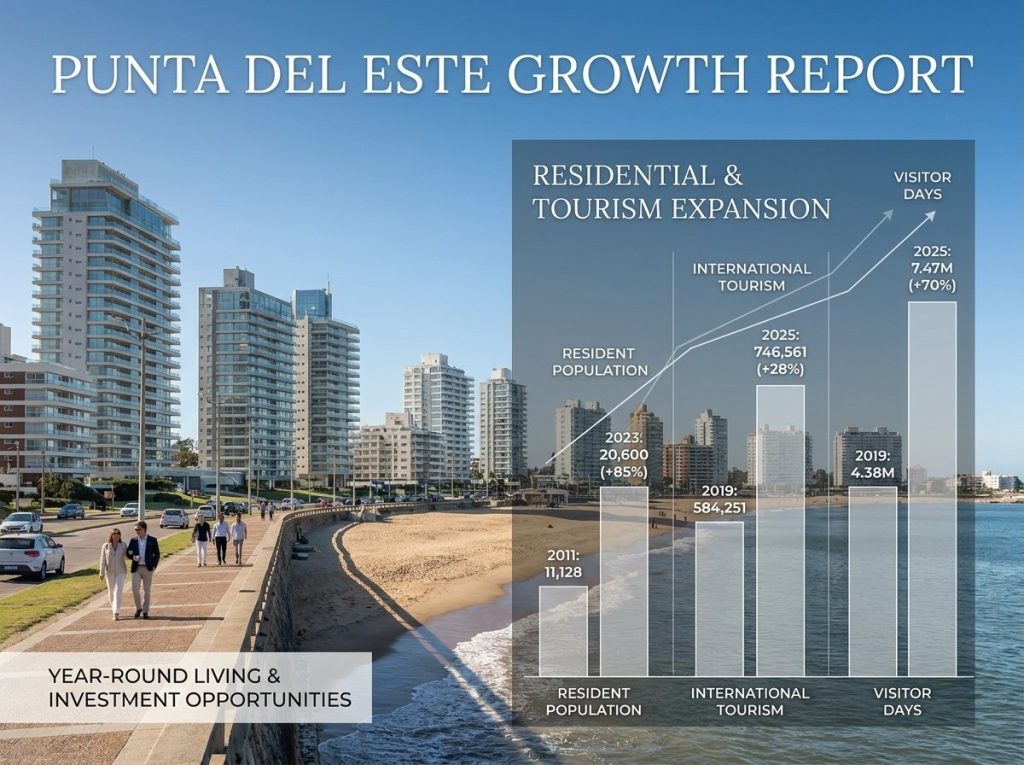
Punta del Este concentrates spending in restaurants, hotels, fashion, home design and premium services, all categories where bank partnerships are frequently visible.
Sources
- Banco Central del Uruguay — supervised banking institutions
- Banco Central del Uruguay — payment-system reports
- DGI — VAT reduction for qualifying electronic payments
- DGI — VAT reduction for specified electronically paid services
- Santander Uruguay — benefits catalogue
- Scotiabank Uruguay — cards and benefits
- Itaú Uruguay — restaurant benefits
- Itaú Uruguay — premium benefits
- BBVA Uruguay — restaurant promotion example
- BROU — benefits catalogue
- Banco Bandes Uruguay
- OCA — benefits and promotions
Considering living or investing in Uruguay?
Punta Select Club is a structured first point of entry for international investors and buyers seeking to understand Uruguay, its property market and its day-to-day operating environment. We provide educational information, market orientation and, where appropriate, introductions through authorized local partners.
Disclaimer
This article is published for informational and educational purposes only. Information reflects the conditions and sources available on the publication date. Bank promotions, card terms, caps, regulations, taxation, public policy and market conditions may change, be suspended or be withdrawn without notice.
All information should be verified directly with the relevant bank, card issuer, merchant, DGI or competent authority before any decision is made. This article is not legal, tax, financial, banking or real-estate advice. Individual circumstances require review by appropriately qualified and, where required, licensed professionals.
Punta Select Club acts as an information, market-orientation and buyer-coordination platform for international investors and purchasers.