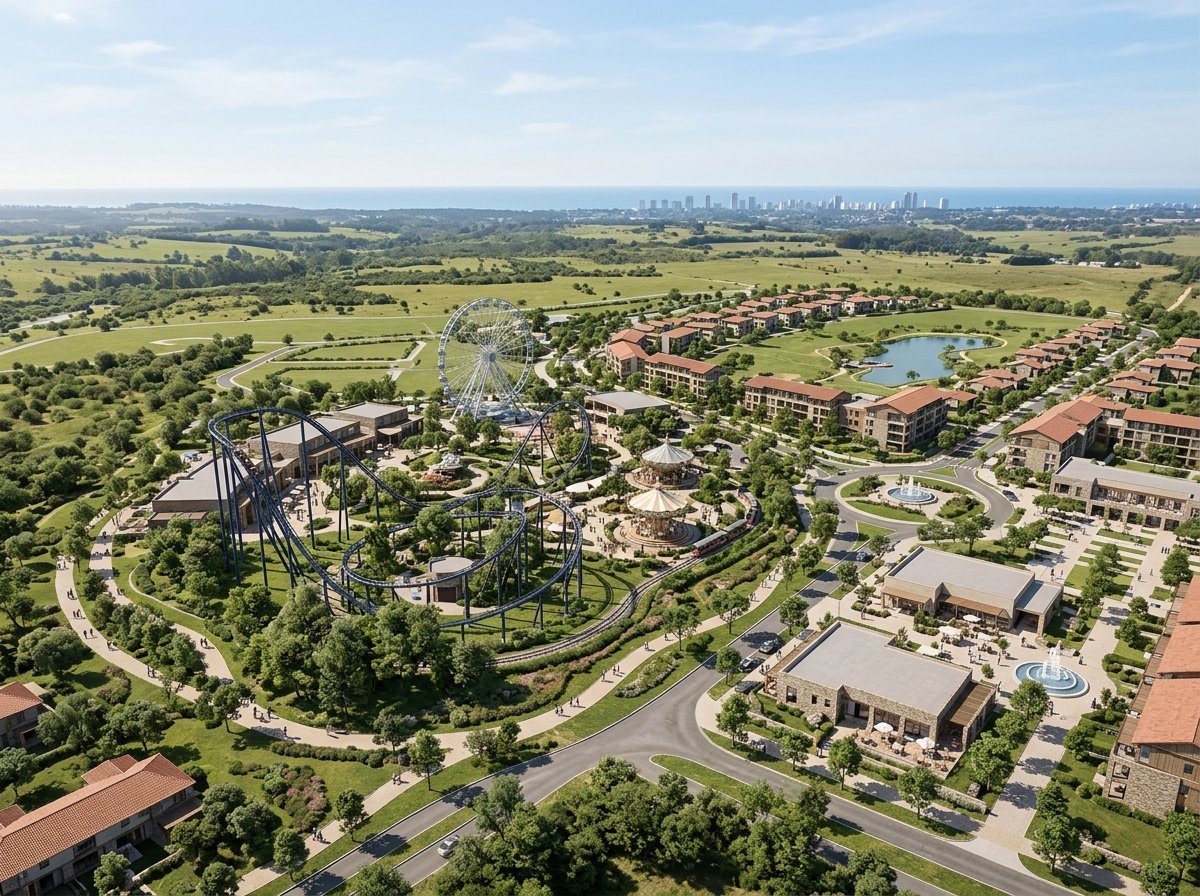
Uruguay’s tourism chamber, CAMTUR, is seeking to create the conditions for one or more international-standard entertainment parks to be developed in the wider Punta del Este area. The objective is to reduce dependence on the summer season, attract more Brazilian visitors throughout the year and stimulate an investment ecosystem around hotels, food and beverage, transport, retail and leisure.
The announcement requires careful interpretation. There is not yet an officially launched park with a named operator, secured site, financing package and construction timetable. What exists is an institutional proposal designed to improve the economic and regulatory conditions for private investment.
That distinction matters for international investors. The long-term potential may be meaningful, but the current opportunity is to understand an emerging policy direction rather than to price a fully de-risked project.
Executive summary
- CAMTUR is promoting a year-round tourism strategy that could include two or three parks or major complementary attractions inspired by the Gramado model in southern Brazil.
- Punta del Este is identified as the strongest potential location because of its hotel capacity, regional brand and access to the Brazilian market.
- The initiative has been presented to the Ministry of Tourism and the Ministry of Economy and Finance and appears in a CAMTUR working paper submitted to the MEF in May 2026.
- The public documents reviewed do not identify an investor, operator, site, budget or delivery schedule. The proposal therefore remains at an institutional and regulatory structuring stage.
- Uruguayan law already provides for themed service free zones covering leisure and entertainment, but applying the regime to a tourism complex open to residents and potentially including hotels raises important legal and tax questions.
What exactly is CAMTUR proposing?
On 28 July 2026, CAMTUR president Fernando Tapia said the chamber was working to create incentives for investment in theme parks or high-quality entertainment parks capable of competing with leading regional attractions. He referred to a gradual process involving two or three parks and several complementary experiences.
The statement is part of a broader programme. In January 2026, CAMTUR, the Ministry of Tourism and the CERES research centre formed a permanent working group to examine tourism competitiveness, profitability and non-traditional investment.
On 21 May 2026, CAMTUR submitted a working paper to the Ministry of Economy and Finance that explicitly identifies theme parks, recreational centres, wellness tourism and integrated developments as strategic projects. The paper also recommends strengthening investment-promotion tools, including COMAP and free zones.
The CAMTUR initiative is institutionally real. It is not yet an awarded, financed or authorised development.
Actual status as of 2 August 2026
| Confirmed | Not publicly confirmed |
|---|---|
| A proposal promoted by CAMTUR | A committed investor |
| Discussions with the tourism and economy ministries | A selected international operator |
| A preference for Punta del Este, Maldonado or potentially Canelones | A selected or acquired site |
| Gramado as a strategic reference | A capital expenditure budget |
| Discussion of incentives and themed service zones | A permitting, construction or opening timetable |
| A year-round tourism and Brazilian-market objective | A published environmental or planning assessment |
The accurate formulation is therefore not that a theme park “will be built” near Punta del Este. CAMTUR is attempting to create the conditions under which private investors may evaluate one or more such developments.
Why the proposal matters for Uruguay
Tourism is economically important but remains exposed to seasonality and high operating costs. The 2026 CAMTUR Tourism Monitor, prepared with CERES, estimates that tourism represented approximately 6.2% of economic activity in 2025, supported more than 122,000 jobs and accounted for close to half of that year’s GDP growth.
CAMTUR’s paper to the MEF also estimates that real tourism revenue is around 16% below historical levels, while operating costs have increased by roughly 9%, producing a combined deterioration of approximately 25 points in sector margins.
The issue is not simply visitor volume. It is the concentration of demand, the cost base and the underuse of infrastructure for much of the year. A leisure cluster with indoor attractions, events and family-oriented experiences could help distribute demand more evenly, extend stays and support a more consistent operating cycle.
Why Punta del Este is the natural candidate
Punta del Este already offers many of the elements a major tourism development would otherwise need to create: a recognised international brand, substantial hotel capacity, a large short-term rental stock, established food and beverage, premium services and direct links with Argentina and Brazil.
Uruguay’s Ministry of Tourism reports that Punta del Este received approximately 748,500 visitors in 2025, generating about USD 918.4 million in expenditure. The destination therefore captured roughly 45% of national inbound-tourism receipts while representing just over one fifth of total visitors.
This spending profile matters. A regional park does not depend on admission revenue alone. Its economics also rely on accommodation, food, transport, merchandising, events and the ability to convert a day trip into a multi-day stay.
Brazil is central to the demand case
CAMTUR views Brazil as Uruguay’s strongest structural tourism-growth market. In 2025, Uruguay received almost 489,700 Brazilian visitors, who generated approximately USD 336.5 million in spending.
In the first half of 2026, Brazilian visitor numbers increased by 4.4%, while total spending rose by 8.1% to approximately USD 170 million. Punta del Este remained the leading destination for this segment.
Azul has announced seasonal services linking Punta del Este with Porto Alegre, Campinas and Belo Horizonte between December and February. A successful year-round leisure cluster could, in theory, help support demand for longer operating periods. Any extension of air services would nevertheless remain a future commercial decision by the airlines, not a confirmed consequence of the proposal.
Gramado: the reference is an ecosystem, not one ride
CAMTUR cites Gramado in Rio Grande do Sul as the benchmark. The important lesson is not a specific number of parks. It is the way the destination combines attractions, events, food, hospitality and an annual calendar to generate multiple reasons to visit.
| Factor | Gramado | Punta del Este |
|---|---|---|
| Historic positioning | Mountain and events destination developed into a year-round leisure cluster | International coastal destination still heavily concentrated in the southern summer |
| Core market | Large Brazilian domestic market | Uruguayan, Argentine, Brazilian and international demand |
| Product mix | Multiple parks, indoor attractions, festivals and experiences | Strong hospitality, food and real estate, but fewer large permanent attractions |
| Access | Large drive-to catchment areas | Greater reliance on air links, ferry connections and regional road travel |
| Main lesson | A diversified ecosystem reduces seasonality | The impact would require a complementary cluster, not a standalone attraction |
For Punta del Este, a more credible model would be phased: indoor attractions, winter programming, events, hotels, food and complementary products capable of serving different segments and weather conditions.
The legal framework: what themed service zones already allow
Uruguay’s Free Zones Law No. 15,921 already contains a chapter on themed service zones. Article 49 allows the Executive Branch to authorise zones for audiovisual services, leisure and entertainment, excluding gambling and betting.
Article 50 requires those zones to be located outside the Montevideo Metropolitan Area, defined as a 40-kilometre radius from central Montevideo. Punta del Este is outside that area.
Article 51 allows the Executive Branch to relax the general retail restriction and permit final consumers who are either Uruguayan tax residents or non-residents. Article 52, however, states that the relevant corporate income tax and VAT exemptions apply exclusively to services supplied to final consumers who are not tax residents of Uruguay.
A tourism-themed zone would therefore not automatically be tax exempt for every admission ticket and every sale. The tax outcome would depend on the activity, the authorised user, the customer profile and the terms of the approval.
Accommodation presents a further issue. Article 4 limits residence within free zones to security and maintenance personnel and certain authorised officials. Integrating hotels inside a themed zone could therefore require a legislative amendment, a special boundary structure or another specific legal solution. This is a general legal reading that should be confirmed by qualified Uruguayan counsel.
Article 10 also requires a private application to include an investment project demonstrating economic viability and benefits for Uruguay. The statutory framework does not remove the need for a specific authorisation, business plan, environmental approvals, planning consent and construction permits.
The Competitiveness Bill remains under discussion
The parliamentary record for the Competitiveness and Cost of Living Reduction Bill shows that, as of 2 August 2026, the proposal remained under review by the Senate Finance Committee. CAMTUR has said it is working on adjustments that could facilitate access by Uruguayan visitors and potentially allow accommodation within strategic tourism projects.
Those elements should be treated as proposals under discussion, not enacted law. The final language may change during the legislative process and would still require implementing regulation.
Potential real-estate and investment consequences
- A longer rental season: demand spread across more months could improve occupancy beyond January and February.
- Permanent housing demand: staff, operators and suppliers could support residential demand in Maldonado and connected corridors.
- Family hospitality and multi-day stays: the visitor profile could differ from Punta del Este’s traditional beach and luxury market.
- Retail and food and beverage: more consistent footfall could improve annual asset utilisation.
- Land and infrastructure: road access, water, sewage, power, parking and public transport would become critical variables.
- Destination positioning: Punta del Este could broaden its identity beyond summer, beaches and residential luxury.
None of these outcomes is automatic. The impact would depend on the site, scale, operator, product quality, pricing, access and delivery timetable.
Where opportunities could emerge
Complementary tourism infrastructure
Hotels, serviced apartments, transport, family dining, indoor leisure, event programming and reservation services could benefit from less weather-dependent demand.
Long-term and medium-stay housing
A permanent attraction requires employees, managers, technicians and suppliers. Demand could therefore extend to Maldonado, Roosevelt and efficient access corridors rather than remaining limited to the most exclusive coastal locations.
Mixed-use development
Combining entertainment, retail, accommodation and event space can diversify revenue but materially increases legal, financial and planning complexity.
Institutional capital
Infrastructure investors, hotel operators and long-duration capital may consider a project supported by a clear concession, experienced operator, committed financing and stable regulation. Those conditions have not yet been publicly established.
Risks and watchpoints
- Execution risk: an institutional proposal may never become an investable project.
- Regulatory risk: proposed reforms may change, be delayed or fail to pass.
- Demand risk: the local market is insufficient without sustained regional traffic.
- Seasonality risk: an overly outdoor product could reproduce the problem it is intended to solve.
- Capital risk: major parks require large upfront investment, continuous renewal and significant marketing expenditure.
- Land speculation risk: purchasing land based on an assumed location would be highly speculative before a site is announced.
- Infrastructure risk: roads, water, sewage, energy and transport can determine the viability of a location.
- Operating risk: a successful foreign concept may not translate directly to Uruguay’s market size and visitor behaviour.
Eight confirmations an investor should require
- The identity of the developer and operator.
- The exact site and legal control of the land.
- Committed capital and financing structure.
- Status of environmental, planning and construction approvals.
- The applicable tax regime confirmed by professional opinion.
- Market study, capacity and attendance assumptions.
- Connectivity and transport plan.
- Phasing of attractions, hotels and complementary services.
Conclusion: a serious initiative, not yet a de-risked project
An international entertainment cluster near Punta del Este would address a genuine economic challenge: turning a highly successful summer destination into a more consistent, diversified and profitable tourism economy.
CAMTUR has incorporated the proposal into a structured technical agenda, presented it to national authorities and identified investment tools that could support large-scale projects. Uruguay also has an existing legal basis for themed leisure zones. These factors give the initiative institutional credibility.
The decisive milestones have nevertheless not been crossed: operator, site, financing, approvals, final regulation and delivery timetable. For international investors, the sensible approach is to monitor those milestones, understand which corridors could benefit from year-round demand and avoid paying today for a value uplift that remains hypothetical.
FAQ — Theme park and investment in Punta del Este
Has a theme park near Punta del Este been officially confirmed?
No. CAMTUR has confirmed the initiative and its intention to attract investment, but public sources available as of 2 August 2026 do not identify an investor, site, budget or opening date.
How many parks are being considered?
Fernando Tapia referred to two or three parks or major attractions with complementary experiences. This is a strategic vision, not an approved construction programme.
Why is Punta del Este the preferred location?
It offers hotel capacity, international recognition, tourism infrastructure, high visitor spending and access to the Brazilian market. It also has a clear need to extend activity beyond the summer.
Why is Brazil important?
Brazil is Uruguay’s strongest regional growth opportunity. Brazilian visitor numbers and spending rose in the first half of 2026, and Punta del Este remained their leading destination.
Could the project operate in a free-zone regime?
Uruguayan law permits themed service zones for entertainment outside the metropolitan area. A specific development would still require Executive approval and compliance with investment, tax and operating requirements.
Could Uruguayan residents enter the zone?
The Executive Branch can permit access and retail sales to resident consumers. However, the corporate income tax and VAT exemptions for services are limited to final consumers who are not Uruguayan tax residents.
Could a hotel operate inside the zone?
The current restriction on residence inside free zones creates a legal issue. A hotel may require legislative change, a special approval or a location outside the free-zone perimeter.
Would the project increase property prices?
That cannot be assumed. A financed and delivered project could support specific locations and segments, but the effect would depend on the site, infrastructure, visitor volumes and timing.
Is it sensible to buy land before the site is announced?
A purchase based solely on location rumours would be highly speculative. Zoning, utilities, title, permits and a verified connection to an officially announced project should be established first.
Sources
- Radio Viva FM — Theme park near Punta del Este: CAMTUR’s year-round tourism proposal, 28 July 2026.
- CAMTUR — Tourism as a strategic sector for national development, working paper submitted to the MEF, 21 May 2026.
- CAMTUR — 2026 Tourism Monitor, prepared with CERES.
- Radio Carve — CAMTUR, Ministry of Tourism and CERES working group, 28 January 2026.
- Uruguay Ministry of Tourism — Annual inbound tourism data for 2025.
- Uruguay Ministry of Tourism — Azul expands Brazil–Punta del Este connectivity, 23 July 2026.
- IMPO — Free Zones Law No. 15,921, particularly Articles 4, 10 and 49–52.
- Uruguayan Parliament — File 173622, Competitiveness and Cost of Living Reduction Bill.
Disclaimer
Published on 2 August 2026 for informational and educational purposes only. The information reflects the sources and knowledge available on the publication date. Projects, laws, regulations, tax regimes, public policies, permits, tourism data and market conditions may change, be amended or never materialise.
All information should be independently verified before any decision is made. This article is not legal, tax, financial, wealth, real-estate or investment advice, and it is not an offer, solicitation or recommendation to buy, sell or finance any asset. Each situation requires independent analysis and advice from appropriately qualified and authorised professionals in the relevant jurisdictions.