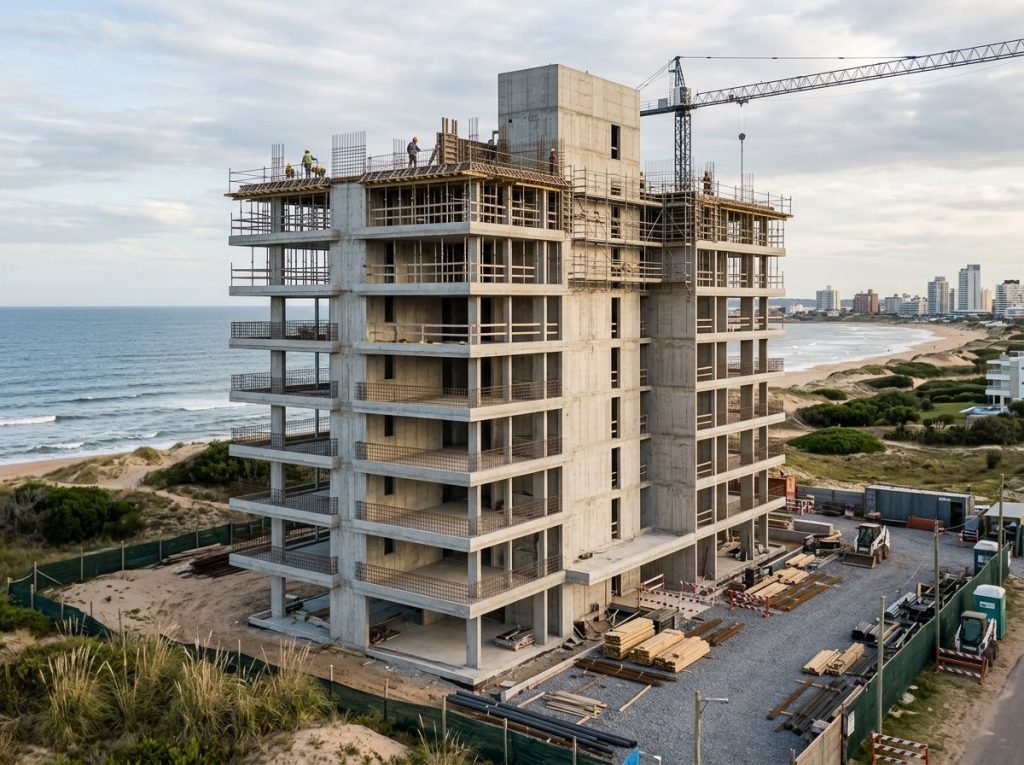

Paraguay’s Ueno Bank crisis is not simply a story about one fast-growing lender. It is a reminder that an attractive tax rate and an impressive GDP growth figure are not substitutes for institutional quality. Punta Select Club made that distinction publicly in July 2026. The intervention of Ueno Bank now gives it immediate relevance for cross-border investors.
Information and reporting reviewed as of November 4, 2026. Resolution proceedings and investigations remain ongoing.
Introduction: our warning was about the framework, not a forecast of failure
On July 28, Punta Select Club published “Uruguay or Paraguay? A Sourced Comparison of Why I Chose Uruguay.” It was not an attempt to dismiss Paraguay’s prospects. We acknowledged its cost advantages, export potential, energy resources and stronger near-term growth. Instead, we asked an investment question that was notably absent from much of the promotional narrative: once capital has been committed, how reliable are the institutions and counterparties responsible for protecting it? [1]
The analysis examined contract enforcement, property records, financial supervision, settlement, market liquidity and the fashionable description of Asuncion as “the next Dubai”. It predated the Ueno Bank intervention by more than three months. We did not predict the failure of this particular institution. We argued that jurisdictional risk belonged in the investment underwriting from day one.
That distinction matters. A credible investment thesis should be tested against new events, not rewritten after the event to claim clairvoyance.
Executive summary
- What happened: Paraguay’s central bank initiated resolution proceedings against Ueno Bank on November 2, 2026, after its solvency ratio was found to be less than half the regulatory minimum. [2]
- Who is exposed: account holders lost access to services during the intervention. The bank reportedly had approximately 2.9 million customers, a figure that should not be treated as the number of distinct adult depositors. [6]
- Foreign depositors: Paraguay’s deposit guarantee scheme explicitly includes non-resident and foreign-currency deposits, subject to statutory limits and exclusions. [3]
- The wider issue: the case raises questions about oversight, related-party exposure and public-sector money, while investigations and political reactions remain unresolved. [5]
- Our position: Paraguay retains legitimate investment uses. For family relocation, understandable property holdings and long-horizon wealth preservation, our preference remains Uruguay’s more established institutional framework.
The Ueno Bank intervention: what is established
The Banco Central del Paraguay (BCP) stated on November 3 that its board had unanimously approved the resolution decision the previous day. Financial statement adjustments made during a regularisation process exposed a capital adequacy shortfall: Ueno’s solvency measure had fallen below 50% of the minimum requirement. The action was taken under Law No. 2334/03, Paraguay’s deposit guarantee and financial-institution resolution framework. [2]
Resolution is not a synonym for every customer losing every deposit. It is a formal process for dealing with a failing institution, valuing assets and liabilities and implementing available recovery or transfer mechanisms. It can, however, produce an immediate loss of access to cash. For a family, an entrepreneur or a property buyer awaiting completion, an inaccessible account may be a material problem even before any ultimate loss is calculated.
Financial-sector concerns have also become political. Reuters reported that central bank president Carlos Carvallo, who previously ran Ueno, submitted his resignation at President Santiago Pena’s request. The president’s former business relationship with the bank’s parent group has attracted scrutiny; prosecutors launched proceedings involving people connected with the bank. Those developments justify questions about oversight. They do not, by themselves, establish criminal liability or misconduct by any particular individual. [5]
The public-sector dimension is equally significant. EFE reported that Paraguay’s social security institution, IPS, had roughly $355 million in Ueno-related holdings, including instruments with different contractual characteristics. Parliament moved to consider an exceptional mechanism for protecting public funds. At the time of writing, a proposed measure should not be mistaken for an enacted, funded guarantee. [6] [7]
Would a European non-resident lose money in the same way?
Foreign nationality does not remove bank-counterparty risk. A French, Spanish, Belgian or other international investor holding an account at the affected bank faces the same operational disruption as a Paraguayan customer. There is, however, an important legal distinction between being exposed to a bank’s failure and being excluded from deposit insurance.
The BCP explicitly lists non-resident deposits and foreign-currency deposits as covered categories under its Fondo de Garantia de Depositos (FGD), subject to scheme rules and exclusions. According to the central bank’s November announcement, the general ceiling applicable to Ueno is 75 monthly minimum wages, then 228.3 million guaranies per depositor per institution, roughly US$38,000 at the contemporaneous exchange-rate reference. [3] [2]
On November 3 the central bank announced an initial payment of up to 10 million guaranies, with later steps to follow an official schedule. Outstanding debts to the bank may be offset before a guaranteed amount is paid. [4]
Consider an eligible $200,000 deposit. The statutory guarantee does not cover that entire amount. Equally, the balance above the guarantee has not automatically been written off: its treatment will depend on the resolution, recovery rates and any legally available transfers. Bank bonds, fund units, subordinated debt and ordinary deposits must not be grouped together under the same protection assumption.
For globally mobile wealth, the lesson is straightforward: obtaining access to an offshore bank account is not the same as securing an enforceable, fully insured claim on the money held there.
What Punta Select Club said in July, before Ueno Bank
Our July comparison deliberately rejected a simplistic contest between a cheap, fast-growing Paraguay and an expensive, mature Uruguay. It looked at the full investment lifecycle: acquiring, funding, operating, defending ownership, collecting income, reselling and moving capital again. A lower tax bill is useful only if an investor can execute the transaction and ultimately receive the expected proceeds. [1]
We also challenged the “next Dubai” narrative. Vertical construction and low headline taxes can generate attention, but they say little about title security, escrow arrangements, developer balance sheets, secondary-market depth, completion risk and the legal treatment of funds. These are underwriting variables, not optional footnotes.
To say that this crisis proves Paraguay is doomed would be analytically unserious. To say it offers no lesson about governance and institutional risk would be equally complacent. The relevant question is not whether a bad event occurs somewhere. It is whether the investor had priced the possibility, assessed the institutional response and limited the concentration of capital exposed to it.
Uruguay versus Paraguay: the institutional gap is measurable
Country indices cannot predict a bank failure or tell investors what any individual asset is worth. Yet they provide a useful independent frame for evaluating the operating environment in which contracts, regulators and courts function.
| Measure | Uruguay | Paraguay | What it assesses |
|---|---|---|---|
| Transparency International, CPI 2025 | 73/100; 17th of 182 | 24/100; 150th of 182 | Perceptions of public-sector corruption; not a finding about particular people. [8] [9] |
| World Justice Project, 2026 | 0.72; 22nd of 143 | 0.45; 98th of 143 | Rule of law, constraints on government, courts and regulatory enforcement. [10] [11] |
| Freedom House, 2026 | 97/100; Free | 63/100; Partly Free | Political rights and civil liberties, not a credit rating. [12] [13] |
| Henley / AlphaGeo, risk and resilience, May 2026 update | 69.28; 34th | 57.43; 87th | A composite investment risk and resilience framework, not a return forecast. [14] |
Uruguay ranks first in Latin America and the Caribbean on the World Justice Project’s overall 2026 rule-of-law measure, and leads Latin America in Transparency International’s 2025 public-sector corruption perceptions ranking. Those are defensible statements. Calling Uruguay the only stable country in South America would not be: other countries in the region also have functioning institutions and credible macroeconomic records. Our argument is about Uruguay’s particularly strong measured institutional position and its fit with our investors’ objectives.
Practical implications include the reliability of property title, predictability of procedures, transparency of decisions, recourse when a counterparty defaults and the capacity to enforce agreements. Institutions are not a guarantee of returns. They influence the conditions under which returns can be realised.
Paraguay’s growth story is real. That does not eliminate financial risk.
An effective comparison must acknowledge the facts that support the other side. In its August 2026 Article IV assessment, the IMF reported 6.6% real GDP growth in Paraguay for 2025 and projected 4.4% in 2026. It highlighted resilient macroeconomic fundamentals, investment and structural reform efforts. These are characteristics of a dynamic economy, not of a country in general economic collapse. [15]
A rapidly expanding economy can nevertheless experience a failure of an individual intermediary. High growth may create more financing opportunities, greater credit expansion and increased competition. None of those forces suspends the need for prudent capital buffers, independent supervision or proper management of connected-party risks.
Investors pursuing high-growth operating businesses, export manufacturing, logistics or agriculture may rationally choose Paraguay. Investors whose first priority is a defensible family residence and long-duration capital preservation will often apply a different weighting to rule of law, banking systems and institutional continuity.
Why Uruguay remains our preferred long-term base
For Punta Select Club, a suitable investment environment is not merely one that promotes capital inflows. It is one in which international buyers can understand what they are purchasing, verify documentation, meet reputable local professionals and plan a transaction without relying on a sequence of untested assumptions.
The IMF’s September 2026 assessment described Uruguay’s banking system as well capitalised, highly liquid and profitable, with bank capital ratios close to twice regulatory minimums. That is a dated sector-wide assessment, not deposit insurance and not a warranty for any named bank. [16]
Transparency requires a point that marketing material might prefer to omit: Uruguay’s statutory deposit protection for foreign-currency deposits is lower than Paraguay’s announced ceiling. Uruguay’s ordinary limit is US$10,000 per depositor per institution for foreign-currency deposits, and 250,000 indexed units for local-currency deposits. Comparing insurance limits alone is therefore an unreliable shortcut to judging overall bank risk; capital, liquidity, asset quality, oversight and resolution effectiveness also matter. [17]
Uruguay’s tax framework deserves similar precision. The 2026 changes brought specified categories of foreign capital income and gains within the personal tax perimeter while introducing a conditional elective impatriate regime for qualifying new residents. A residence permit does not automatically establish tax residence; a property purchase does not deliver a universal tax holiday; and leaving Europe requires a separate analysis of home-country residence, reporting and exit rules. [18]
Punta del Este’s established international residential market offers another part of the proposition: recognised neighbourhoods, longstanding regional buyer demand and an understandable lifestyle use case. None of that justifies overpaying. Off-plan risk, title, construction standards, common charges, seasonality and resale liquidity still require independent scrutiny.
Implications, opportunities and the risks investors should not overlook
Bank liquidity is a separate investment risk
A property may be sound while the account holding the transaction funds becomes inaccessible. An investor may own a viable business but lose the ability to meet payroll during a banking intervention. Cash custody, financial instruments and operational payment rails therefore deserve their own due diligence and contingency plans.
Governance is more than legislation on paper
The design of a supervisory regime matters, but so do its implementation, the independence of decision-making, the treatment of related-party transactions and the quality of public disclosure. The Ueno investigations should establish the facts of this particular case. The broader lesson does not depend on presuming an outcome.
A crisis is not a reason to ignore Paraguay’s investable sectors
There may be sound, appropriately priced industrial, energy-intensive, agricultural and export opportunities in Paraguay. They require the right legal structure, local execution capacity, counterparties and risk premium. Panic transfers to another jurisdiction without tax, legal and banking planning are not a substitute for an orderly investment strategy.
Uruguay’s own limitations remain relevant
Uruguay has a higher cost base, a small domestic economy and non-trivial challenges involving productivity, fiscal performance and public security. Prime property can be expensive and illiquid; seasonal letting assumptions can be optimistic. A strong national institutional score will not rescue a poorly negotiated acquisition.
Seven questions before committing cross-border capital
- Is the exposure a guaranteed deposit, a debt security, a fund holding, a property deposit or an ownership interest?
- What is the legally enforceable protection, and what are its exclusions and per-bank limits?
- What do public financial statements show about capital, liquidity, concentration and related-party lending?
- For new property, who controls deposits, what guarantees completion and what happens if the developer fails?
- Are valuations based on completed transactions, independently verified rental demand and realistic exit liquidity?
- Can funds be transferred, documented and repatriated without assuming uninterrupted access to a single counterparty?
- Have properly authorised and independent professionals reviewed both the destination jurisdiction and the investor’s tax and legal obligations at home?
Conclusion: the point was not to predict a crisis, but to choose a better risk framework
Our public argument in July was that a jurisdiction should be assessed by the full quality of its investment environment, not by headline taxation or promotional growth scenarios. The Ueno Bank episode makes the cost of neglecting that distinction much easier to see. It does not demonstrate that every Paraguayan bank is unsafe or that Paraguay has no investment future.
Uruguay remains Punta Select Club’s preferred starting point for international families and long-term property investors who place a high value on institutional predictability, transparent processes and capital preservation. That is an editorial and commercial preference grounded in specified criteria, not a claim that risk disappears at the border.
Frequently asked questions: Ueno Bank and Uruguay versus Paraguay
Has Ueno Bank definitively failed, with all deposits lost?
No such conclusion was established as of November 4, 2026. The BCP initiated a formal resolution process after finding a severe solvency shortfall. Access to accounts was disrupted, but the final allocation of recoveries, transfers and losses depends on the legal proceedings. [2]
Are foreign and non-resident depositors eligible for Paraguay’s deposit guarantee?
Yes, the central bank lists both non-resident and foreign-currency deposits as covered categories. Eligibility remains subject to the nature of the holding and statutory exclusions. A bank bond or investment-fund unit should not be treated as an ordinary insured deposit. [3]
What was the announced Ueno deposit guarantee limit?
It was 75 monthly minimum wages, equivalent to 228.3 million guaranies per depositor and institution at the time. The BCP also announced an initial payment of up to 10 million guaranies, with subsequent stages to follow official instructions. [2] [4]
Does the intervention mean Paraguay’s entire banking system is collapsing?
No. The action was directed at one institution. The authorities and representatives of the banking sector stated that other banks were continuing to operate. Confidence effects should be monitored, but contagion is not an established fact. [6]
What did Punta Select Club publish before the scandal?
Our July 28, 2026 Uruguay-versus-Paraguay article examined institutional strength, banking relationships, contract enforcement, real-estate due diligence and the risks of the “next Dubai” sales narrative. It did not forecast Ueno Bank’s collapse, but made the case for prioritising legal and institutional predictability. [1]
Is Uruguay demonstrably stronger on rule of law and public integrity?
On the cited measures, yes: Uruguay scores materially better in the 2025 Corruption Perceptions Index and 2026 World Justice Project index. These are independent comparisons of institutional conditions, not guarantees for individual assets. [8] [10]
Is Uruguay’s deposit insurance limit higher than Paraguay’s?
Not for foreign-currency deposits. Uruguay’s standard limit is US$10,000 per person and institution for foreign-currency balances, and 250,000 indexed units for local-currency deposits. The ceiling should be considered alongside bank capital, supervision and portfolio concentration. [17]
Does buying property in Uruguay automatically provide tax residence or eleven years of tax exemption?
No. Legal residence, tax residence and access to a particular tax regime are distinct questions. The 2026 elective impatriate framework applies to defined income categories and eligible individuals under specified conditions. Home-country tax rules must be assessed separately. [18]
Sources and methodology
Primary central-bank statements underpin the chronology, supplemented by dated Reuters and EFE reporting. Institutional comparisons rely on explicitly dated international benchmarks. Punta Select Club’s July 2026 publication independently establishes the earlier editorial position. The review also considered user-supplied tax briefings, economic materials, Henley & Partners and Visual Capitalist documentation; key claims were cross-checked against primary sources where possible. This is a snapshot as at November 4, 2026, not an ongoing legal or bank-resolution assessment.
- Punta Select Club, Uruguay or Paraguay: sourced comparison, July 28, 2026.
- Banco Central del Paraguay, resolution of Ueno Bank, 3 November 2026.
- Banco Central del Paraguay, Fondo de Garantia de Depositos: coverage and exclusions.
- Banco Central del Paraguay, deposit guarantee payment announcement, 3 November 2026.
- Reuters, Central Bank leadership resignation and Ueno Bank, 3 November 2026.
- Agencia EFE, Ueno Bank intervention and public funds, 4 November 2026.
- Honorable Camara de Diputados de Paraguay, proposed law for public deposits.
- Transparency International, Corruption Perceptions Index 2025: Uruguay.
- Transparency International, Corruption Perceptions Index 2025: Paraguay.
- World Justice Project, Rule of Law Index 2026: Uruguay.
- World Justice Project, Rule of Law Index 2026: Paraguay.
- Freedom House, Freedom in the World 2026: Uruguay.
- Freedom House, Freedom in the World 2026: Paraguay.
- Henley & Partners / AlphaGeo, Global Investment Risk and Resilience Index, 2026.
- International Monetary Fund, Paraguay Article IV consultation, 28 August 2026.
- International Monetary Fund, Uruguay Article IV mission statement, 24 September 2026.
- Corporacion de Proteccion del Ahorro Bancario (Uruguay), deposit insurance limits.
- Direccion General Impositiva (Uruguay), new fiscal residents framework from 2026.
Approach Uruguay with informed access, not untested promises
Considering a move to Uruguay, a second home or a property investment in Punta del Este or Maldonado? Punta Select Club provides a private investor community, market orientation, selected access to relevant property opportunities and buyer coordination, with introductions through authorised local partners where specialist input is required. For new developments, off-plan purchases and pre-construction projects, Punta Select Club charges no buyer-side commission.
Important disclaimer
This article is provided solely for informational and educational purposes and reflects information available as of November 4, 2026, while Ueno Bank’s resolution and related investigations were ongoing. Law, bank regulation, deposit protection, tax rules, residence requirements, public policy and market conditions may change; facts should be independently checked before acting. No recovery of funds, banking safety, return, property appreciation or tax outcome is guaranteed. Nothing in this article is legal, tax, financial, banking, real-estate or investment advice, an offer or a solicitation. Each case requires assessment by appropriately qualified and authorised independent professionals in the relevant jurisdictions. Punta Select Club operates as an educational information platform, private investor community, market-orientation and buyer-coordination service. It is not a real-estate agency, broker, regulated advisory firm, law firm, tax adviser, wealth manager or investment fund.